



One of our sales representatives will contact you shortly.
Every business, regardless of the size or maturity phase, can benefit from better technologies and services, when perfecting its procurement processes. Therefore, if you have a project to be executed, an event to organize or the deployment of a new system, begin from the following steps.
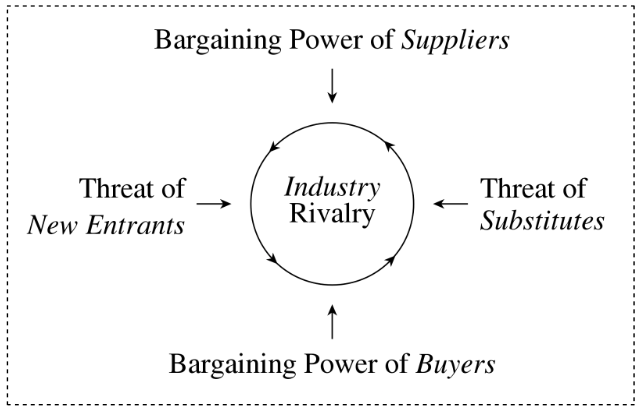
In 1979, Harvard Business Review published for the first time a framework called Porter’s Five Forces. Created by Michael E. Porter, academic at Harvard University, it became a classic and a mandatory tool for strategists and planners. It evaluates how competitive your business can be, based on the following 5 factors.
Notice that, out of 5 forces, 2 involve Bargaining Power. So, according to that, we can conclude that some 40% of your business competitiveness comes from the quality of deals you close.
And a multi-vendor acquisition process increases both the bargaining power and purchasing capacities of your company. For that, we got a very well-known tool called RFP.
An RFP, or Request for Proposal, is nothing else than a document that you’ll send to several vendors, requesting them to submit their proposals for the product or service you’re interested.
An RFP should contain as much information as possible. Thus, suppliers can use their creativity to provide their best solution to your company.
Therefore, the elaboration of an RFP is key to ensure procurement efficiency. It has to follow a methodology common to project management, using specific techniques and requirements analysis.
a. Understand the complexity of so many vendors and their pricing models
First of all, create a contact list of suppliers - for both the ones you plan to contact, plus the ones you’ve bought from on previous occasions. This helps in evaluating results, choosing vendors for future projects and set more efficient partnerships in the medium and long term.
Notice that, if your business still didn’t reach a certain maturity, trying to squeeze suppliers might not be a good strategy. In the long term, it can compromise relationships and cause a rejection of the market in doing business with your company.
The partnership should be aligned by objectives and overall business strategies, such as: quality, cost and/or innovation. Ideally, a vendor would combine all of these factors. But being more realistic, they usually blend two of those in detriment of a third one. For example: if you’re looking to hire a CRM, Salesforce is long known for differentiating their product by quality + innovation. Thus, don’t expect them to have the cheapest cost.
b. Getting in touch with vendors
At this moment, don't be afraid to demand as many details as needed. Establish guidelines and requirements that apply to all vendors.
Create a list of questions about what you expect from this product, service or software. So, the competing vendors know they’re in charge of answering it.
Ask questions such as how long the company has been in the business and what type of industry it usually serves. This will help you hire a company taking market relevance into account.
Get to know all the products and services that suppliers have the capacity to deliver. This will clarify that they can keep up with what they promise you.
Point out the most complex points of the project and when you’ll need them ready. It’ll help you on avoiding negative surprises regarding deadlines when the project is already in progress.
Ask about the discrimination of every cost and how the total price is gonna be broken down in the contract. It’s how you’ll avoid hidden fees or misunderstanding about money.
c. Testing vendors with the highest possible efficiency
For example, if an RFP is about a new software to be used by the company, ask if the product has the integrations with platforms you’re already using. Make sure about the quality of support and onboarding training. Go beyond financial worries.
Many companies, especially tech providers, also offer freemium versions or trials of their products.
Freemium are basic software versions, without an expiry date. However, due to its limitations, it’s hard to know if the full software version will attend your needs. That’s what we see at Hubspot, for instance.
Softwares that offer a trial period instead, can usually be tested without resource limitations. Nevertheless, this vendor can be tested on its full capacity. On the other hand, you’ll have a limited amount of time – usually 7 to 30 days – to get into a conclusion about closing a deal or not. Currently, InEvent is a good example of growth strategy evolving around this business model.
d. Choosing the winner with transparency and making results clear for all of the others
From the first version of your RFP to the final selection of the winning vendor, every process must have clear and well defined rules.
e. Enforce your company compliance and avoid deviations by adding these rules to your ethics and conduct manuals.
It's a common mistake to confuse agility and harassment. In the chase of rapid processes, it’s also common to pass on bad and evasive briefings. Especially at the beginning of the process, pay attention to these topics. They'll make sure you run a transparent and correct selection process.
When announcing the winner, be punctual and respect the expectation that has been created.
Providing a short feedback for those who did not make it is also very valuable. Though it's not mandatory, vendors that didn't make it will probably increase their respect for your brand, as well as their efforts when trying to work with you again.Among the benefits of using an RFP in the procurement process, we can highlight:
Several supplier proposals;
Diminishment of subjectivity from decision making;
Raise of bargaining power of your company;
Transparency and compliance;
A formal, repeatable and scalable process.
In summary: providing interested suppliers with tough rules is necessary. It’s ok to be demanding. But throughout the RFP action plan, make clear that the selected vendor can count on your side to do the same. If quality and punctuality are must-have criteria for selecting the winner, use the situation to give the example and you’ll raise up your business partnerships quality significantly.