


One of our sales representatives will contact you shortly.
At a medical congress, “badge swapping” is not just annoying. It contaminates accreditation records, breaks restricted-access rules, and creates sponsor compliance exposure. The entrance system must do three things simultaneously:
Confirm identity (not just scan a QR code).
Apply role-based access (e.g., HCP vs non-HCP).
Create an auditable event log (time-stamped, exportable).
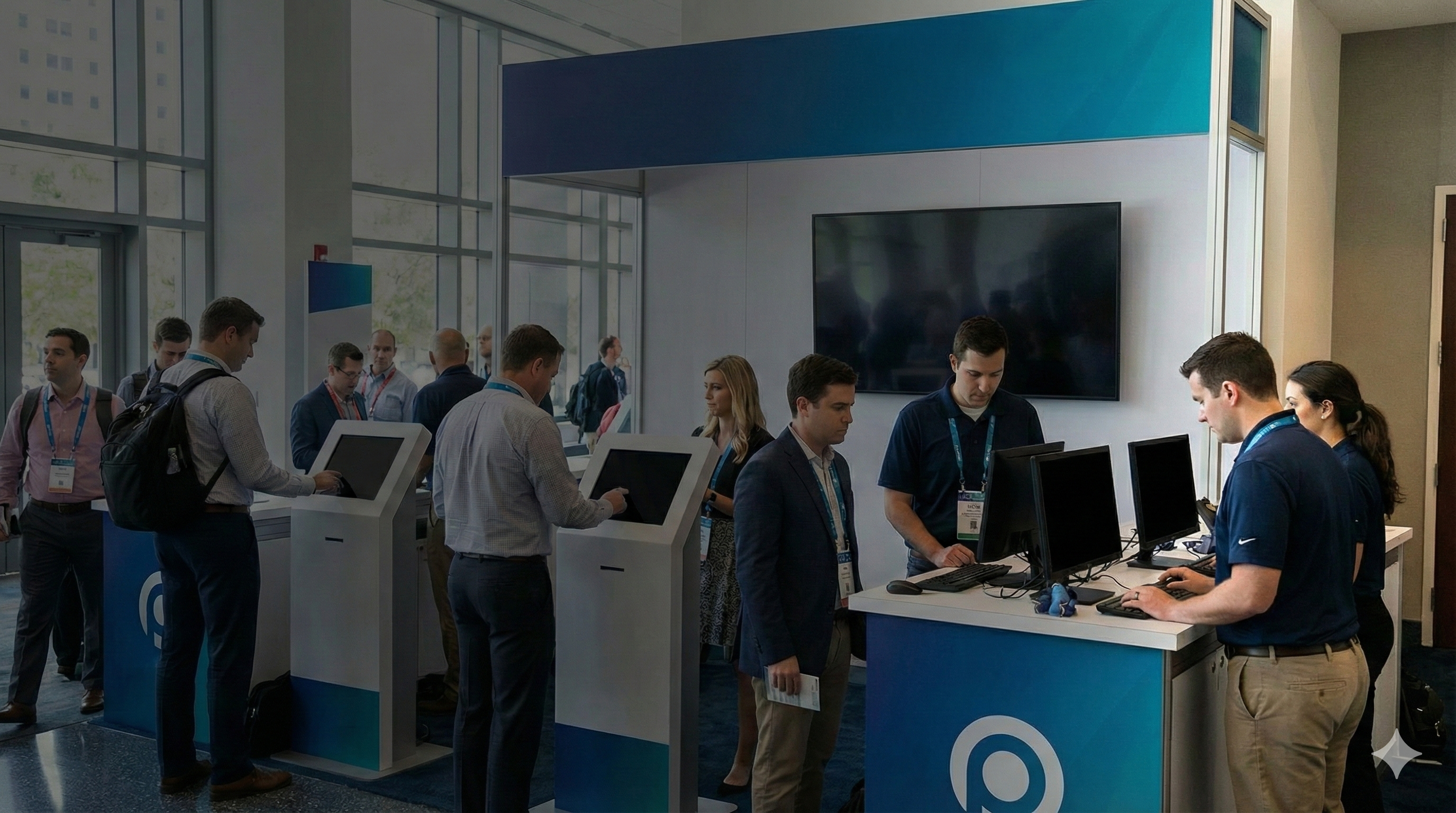
InEvent supports kiosk-based check-in with AI facial recognition as an identity verification layer, designed to reduce fraud and accelerate flow.
Badge swapping happens when the system allows “credential possession” to substitute for “credential ownership.” Common patterns:
Staff hand out pre-printed badges without identity confirmation.
QR codes are forwarded or screenshot and reused.
Attendees check in colleagues “because the line is long.”
Restricted sessions rely on paper sign-in sheets.
Fixing this is not about adding friction. It is about replacing manual discretion with a consistent verification workflow.
A robust medical-meeting entrance can be designed as:
Attendee arrives with QR (email, Apple Wallet, Google Wallet) or name lookup.
Kiosk check-in validates the registration record.
Optional photo match confirms the person matches the credential.
Badge prints with visible role indicators and encoded ID.
Record created: check-in time, device, operator context, and status.
InEvent’s kiosk experience explicitly positions AI facial recognition as a check-in verification method.
For pharma-heavy meetings, the badge needs to communicate access constraints instantly. Recommended visible fields:
Full name
Organization
Role label (e.g., Prescriber, Non-Prescriber, Student, Exhibitor, Staff)
QR code (or other scannable identifier)
Optional: country, specialty, registration category
InEvent supports configurable badge layouts and multiple badge templates, enabling clear role labeling.
If your event operations involve protected health information (PHI), you need a vendor posture that supports HIPAA contracting. Under HIPAA, covered entities typically use business associate agreements (BAAs) to ensure PHI safeguards when a vendor creates, receives, maintains, or transmits PHI on their behalf. (HHS). InEvent states HIPAA compliance and that a BAA can be requested through customer success.
CME is not a “certificate feature.” CME is an evidence chain:
Who was eligible?
What did they attend?
When did they enter and exit?
Did they meet the required duration?
Can you reproduce this during an audit?
Manual sign-in sheets fail because they do not prove time-on-task. Manual badge scans at the door can prove entry, but not duration, unless you require exit events as well.
The simplest audit-grade model is:
Scan IN at session entry.
Scan OUT at session exit.
Calculate duration automatically.
Apply credit rules (thresholds, partial credit rules, minimum seat time).
InEvent’s access control documentation explicitly describes using session scanning to check attendees in and out.
InEvent also describes continuing education attendance tracking that records in/out times and duration of stay.
The rule enforcement you actually want
A typical CME planner pain is retroactive Excel triage:
“They left early but are claiming full credit.”
“They attended overflow. Did it count?”
“They scanned in late. How much credit do they receive?”
With scan-in/scan-out plus duration logic, you can run rules like:
If duration < threshold, deny the credit unit.
If duration meets threshold, grant the credit unit.
If multiple scans exist, keep the first IN and last OUT as the official window.
Flag anomalies (e.g., OUT without IN, multiple devices, improbable session hopping).
The goal is not punishment. It is data integrity.
Once you have trusted attendance data, certificate delivery becomes automation, not a manual mailing project. InEvent provides automated certificate capabilities and scheduling certificates to be sent after the program. (inevent.com)
Operational best practice: do not release certificates until the attendance record is finalized (late scans, door devices synced, exceptions reviewed).
At minimum, your session attendance export should include:
Learner identifier
Session identifier
IN timestamp
OUT timestamp
Duration
Credit unit(s) awarded
Exceptions flagged (if any)
This is the dataset you use for accreditation reconciliation and for internal QA.
Poster operations break when they are treated as a room assignment problem instead of a publishing problem. Common failure modes:
No centralized index, so attendees cannot find posters quickly.
Last-minute poster swaps with no record of what was presented.
No way to capture Q&A or follow-ups.
Poor visibility for digital attendees.
You have three practical models:
Mobile-first poster library: Attendees browse a searchable list, filter by topic, author, institution, keywords, and save favorites.
E-poster kiosks / terminals: Touchscreen stations let attendees browse thousands of posters without physical boards. (faq.inevent.com)
Hybrid model: Physical posters remain, but every poster also has a digital record, improving discoverability and continuity.
InEvent supports publishing abstracts, posters, and presentations through a mobile-optimized searchable interface. (inevent.com)
InEvent’s e-poster guidance positions e-posters as usable for in-person and virtual contexts. (faq.inevent.com)
If you want Q&A at scale, design it as a tracked workflow:
Poster page includes Ask the Author.
Questions are logged, time-stamped, and associated with the poster ID.
Authors receive questions in a controlled channel and can respond asynchronously.
This becomes useful data:
Which posters drew the most engagement?
Which topics trend year-over-year?
Which authors are magnets for discussion?
Medical meetings often need to control access and distribution:
Limit poster access to registered attendee roles.
Apply visibility windows (e.g., poster available during congress dates plus 30 days).
Ensure you can remove or redact content quickly if required.
Treat posters like governed content, not social posts.
Pharma exhibitors do not just want “leads.” They want:
Proof of booth traffic
Proof of interactions
Segmentation (HCP type, specialty if collected appropriately)
Exports that align with internal compliance workflows
Under the Open Payments (Sunshine Act) framework, certain entities must report payments and other transfers of value to covered recipients, and this data becomes publicly available. (CMS)
This is why sponsor teams care about interaction logs. They are trying to reconcile onsite engagement with internal reporting, approvals, and audit trails.
InEvent provides lead retrieval / data collection tooling for exhibitors and sponsors, including QR-based capture and reporting. (faq.inevent.com)
Exports can include additional attendee information and custom registration questions, which matters for segmentation and governance. (faq.inevent.com)
Operational stance: Your platform is not the Open Payments filing system. Your platform is the evidence layer that reduces ambiguity.
Consent and data minimization: what “safe” looks like
For medical meetings, your exhibitor capture policy should be explicit:
What data can be captured at the booth?
What data is restricted?
What requires attendee opt-in?
InEvent describes GDPR tooling such as consent management and audit logs. (inevent.com)
Design your booth capture forms so that consent is not implied, and so data collection stays within your event’s policy.
Good monetization mechanisms:
Sponsored sessions with gated scanning (counts, not sensitive fields)
Sponsored pins in the app (visibility, not data extraction)
Sponsored notifications within clear communication preferences
Avoid monetization that incentivizes collecting unnecessary personal data “because we can.”
When a keynote hits capacity, the failure mode is predictable:
Staff eyeballs the door.
People push in anyway.
Overflow becomes chaotic.
You cannot prove who was where, which breaks CME tracking.
A defensible pattern:
Set a session capacity in your operational plan.
Scan attendees at entry.
When capacity is reached, mark the session “full” and direct new arrivals to overflow.
Scan overflow entry as a separate session ID.
Award credit based on the correct attended location.
Session scanning that supports check-in and check-out is the base mechanism you need to implement this logic.
If overflow is a live stream room, treat it as:
a separately tracked activity, or
an attendance source linked to the same credit rule set.
The rule remains the same: credit should be based on verified duration, not self-attestation.
Medical congresses are international by default. Accessibility is not optional. It increases comprehension, reduces risk, and improves scientific equity.
InEvent supports audio interpretation channels with multiple language options and attendee language selection. (inevent.com)
InEvent offers closed captions for live content and describes automatically generated subtitles in-session. (inevent.com)
For broader accessibility strategy, captions also reduce cognitive load for non-native speakers and improve information retention.
For medical societies and pharma stakeholders, accessibility capability signals operational maturity:
Standardized delivery
Reduced ad-hoc workflows
Medical meetings are not just events. They are regulated environments operating under scrutiny from accrediting bodies, compliance teams, legal counsel, and sponsors. While much of the compliance groundwork happens months in advance—contracts, disclosures, learning objectives—the onsite layer is where theory meets reality. And where risk most often enters.
Unlike general conferences, medical meetings must prove three things simultaneously:
The right people attended
They attended the right sessions for the required duration
Data collection and access were controlled, minimal, and auditable
Onsite technology is not there to “enhance engagement.” Its primary job is control. Control of identity, access, time, and data.
When that control fails, consequences follow: invalidated CME credits, failed audits, sponsor exposure, and reputational damage that extends beyond a single event. This is why medical meetings require a fundamentally different onsite technology posture than commercial or association events.
In medical meetings, identity is not optional metadata. It is the backbone of every compliance decision that follows.
Most failures start here—not because teams ignore identity, but because they rely on self-asserted identity without verification. In low-risk events, that may be acceptable. In CME environments, it is not.
Every attendee must be categorized at registration and enforced onsite. Typical categories include:
Healthcare Professionals (HCPs)
Non-HCPs
Faculty
Staff
Exhibitors
Media
These roles are not cosmetic. They dictate:
Session access
Badge design
Data visibility
Eligibility for credit
Sponsor interaction rules
Onsite systems must ensure these roles are visible, enforceable, and machine-readable.
In medical meetings, badges do real work. They must:
Clearly display role classification
Encode identity through QR or RFID
Support fast visual validation by staff
Ambiguous badges create friction at session doors and increase reliance on manual judgment, which is neither consistent nor auditable. A compliant badge answers one question instantly: Should this person be here?
CME credit is not granted for presence at the venue. It is granted for documented participation in accredited sessions, under defined rules.
This requires session-level enforcement that most generic event platforms are not designed to handle.
Accredited sessions must enforce:
Entry scan
Exit scan
Minimum duration thresholds
This creates a time-based attendance record rather than a binary “was present” flag. Without scan-out, you cannot prove duration. Without duration, you cannot defend credit allocation.
Onsite technology must support:
Door-level scanning
Timestamp accuracy
Offline operation (Wi-Fi is not a control)
Real-time exception handling
Late arrivals. Early exits. Device failures. These will happen.
What matters is whether your system:
Flags exceptions automatically
Applies predefined policies consistently
Produces a defensible audit trail
Manual overrides without logging introduce compliance risk. Exception handling must be rule-based and reviewable, not ad hoc.
Poster halls at medical meetings are increasingly digital, searchable, and sponsor-adjacent. This creates opportunity—and risk.
The challenge is to increase scientific visibility without leaking sensitive data.
Abstract submission systems must:
Separate author-facing workflows from attendee-facing discovery
Restrict internal reviewer access by role
Control when content is published onsite
Onsite poster libraries should expose:
Titles
Authors
Keywords
Approved content only
They should not expose:
Draft materials
Reviewer comments
Internal scoring
Author contact data unless explicitly permitted
This requires deliberate taxonomy, role-based permissions, and publication timing controls.
Sponsors at medical meetings want leads. Compliance teams want restraint.
Both are correct.
The job of onsite technology is to enable sponsor ROI without expanding data risk.
Exhibitor lead retrieval should:
Respect attendee role restrictions
Enforce consent language
Limit captured fields to approved datasets
Produce clean, exportable reports
“Just in case” data collection is a liability in regulated environments. If a data field is not operationally required, it should not be captured.
Sponsors should only see:
Data from attendees who engaged with them
Fields approved by the organizer
Exports governed by contractual terms
Anything else creates exposure for the organizer, not the sponsor.
Medical meetings often take place in convention centers with inconsistent connectivity. Relying on live internet access for compliance-critical workflows is a mistake.
Onsite systems must:
Store scans locally
Sync when connectivity resumes
Preserve timestamps
Prevent data loss during network interruptions
If scanning fails during a session because Wi-Fi drops, compliance fails. Offline mode is not about convenience—it is about continuity of evidence.
The real test of onsite technology is not event day. It is the audit that may follow months later.
Accrediting bodies do not ask how engaging your event was. They ask:
Who attended
What they attended
For how long
Under what rules
With what controls
Audit readiness means:
Structured exports
Role-based access logs
Time-stamped attendance records
Clear linkage between identity and session participation
If you cannot produce this cleanly, quickly, and confidently, your onsite system is not fit for medical meetings—no matter how polished the interface looks.
In medical meetings, control is not the enemy of experience. It is the experience.
Attendees expect:
Fast check-in
Clear access rules
Predictable credit tracking
Trust that their data is handled responsibly
When onsite technology is designed correctly, it fades into the background. Lines move. Doors scan. Credits accrue. And compliance happens quietly, without drama.
That is the real goal of onsite technology in medical meetings:
to make compliance invisible, defensible, and reliable—every time.
1) Data classification and contracts
Define what counts as PHI in your event context.
If PHI is involved, align your vendor contracting posture and ensure appropriate agreements are in place. HIPAA BAAs are a standard mechanism for covered entities working with vendors handling PHI. (HHS)
InEvent states HIPAA compliance and BAA availability on request. (inevent.com)
2) Identity model
Define registration categories (HCP, non-HCP, exhibitor, staff).
Define verification requirements (basic QR vs enhanced photo match for restricted access).
Define badge visual standards (role label must be obvious).
3) CME rule model
For each accredited session, define:
credit value
minimum duration threshold
scan-in/scan-out enforcement
exception handling policy
4) Device plan
Entrance kiosks for throughput.
Handheld scanners for session doors.
Backup devices pre-configured and charged.
Offline contingency plan (venue Wi-Fi is not a control, it is a dependency).
5) Poster publishing workflow
Submission and review timeline (abstract management).
Poster library taxonomy (keywords, topics, authors).
Medical meetings are not just events. They are regulated environments operating under scrutiny from accrediting bodies, compliance teams, legal counsel, and sponsors. While much of the compliance groundwork happens months in advance—contracts, disclosures, learning objectives—the onsite layer is where theory meets reality. And where risk most often enters.
Unlike general conferences, medical meetings must prove three things simultaneously:
The right people attended
They attended the right sessions for the required duration
Data collection and access were controlled, minimal, and auditable
Onsite technology is not there to “enhance engagement.” Its primary job is control. Control of identity, access, time, and data.
When that control fails, consequences follow: invalidated CME credits, failed audits, sponsor exposure, and reputational damage that extends beyond a single event. This is why medical meetings require a fundamentally different onsite technology posture than commercial or association events.
In medical meetings, identity is not optional metadata. It is the backbone of every compliance decision that follows.
Most failures start here—not because teams ignore identity, but because they rely on self-asserted identity without verification. In low-risk events, that may be acceptable. In CME environments, it is not.
Every attendee must be categorized at registration and enforced onsite. Typical categories include:
Healthcare Professionals (HCPs)
Non-HCPs
Faculty
Staff
Exhibitors
Media
These roles are not cosmetic. They dictate:
Session access
Badge design
Data visibility
Eligibility for credit
Sponsor interaction rules
Onsite systems must ensure these roles are visible, enforceable, and machine-readable.
In medical meetings, badges do real work. They must:
Clearly display role classification
Encode identity through QR or RFID
Support fast visual validation by staff
Ambiguous badges create friction at session doors and increase reliance on manual judgment, which is neither consistent nor auditable. A compliant badge answers one question instantly: Should this person be here?
CME credit is not granted for presence at the venue. It is granted for documented participation in accredited sessions, under defined rules.
This requires session-level enforcement that most generic event platforms are not designed to handle.
Accredited sessions must enforce:
Entry scan
Exit scan
Minimum duration thresholds
This creates a time-based attendance record rather than a binary “was present” flag. Without scan-out, you cannot prove duration. Without duration, you cannot defend credit allocation.
Onsite technology must support:
Door-level scanning
Timestamp accuracy
Offline operation (Wi-Fi is not a control)
Real-time exception handling
Late arrivals. Early exits. Device failures. These will happen.
What matters is whether your system:
Flags exceptions automatically
Applies predefined policies consistently
Produces a defensible audit trail
Manual overrides without logging introduce compliance risk. Exception handling must be rule-based and reviewable, not ad hoc.
Poster halls at medical meetings are increasingly digital, searchable, and sponsor-adjacent. This creates opportunity—and risk.
The challenge is to increase scientific visibility without leaking sensitive data.
Abstract submission systems must:
Separate author-facing workflows from attendee-facing discovery
Restrict internal reviewer access by role
Control when content is published onsite
Onsite poster libraries should expose:
Titles
Authors
Keywords
Approved content only
They should not expose:
Draft materials
Reviewer comments
Internal scoring
Author contact data unless explicitly permitted
This requires deliberate taxonomy, role-based permissions, and publication timing controls.
Sponsors at medical meetings want leads. Compliance teams want restraint.
Both are correct.
The job of onsite technology is to enable sponsor ROI without expanding data risk.
Exhibitor lead retrieval should:
Respect attendee role restrictions
Enforce consent language
Limit captured fields to approved datasets
Produce clean, exportable reports
“Just in case” data collection is a liability in regulated environments. If a data field is not operationally required, it should not be captured.
Sponsors should only see:
Data from attendees who engaged with them
Fields approved by the organizer
Exports governed by contractual terms
Anything else creates exposure for the organizer, not the sponsor.
Medical meetings often take place in convention centers with inconsistent connectivity. Relying on live internet access for compliance-critical workflows is a mistake.
Onsite systems must:
Store scans locally
Sync when connectivity resumes
Preserve timestamps
Prevent data loss during network interruptions
If scanning fails during a session because Wi-Fi drops, compliance fails. Offline mode is not about convenience—it is about continuity of evidence.
The real test of onsite technology is not event day. It is the audit that may follow months later.
Accrediting bodies do not ask how engaging your event was. They ask:
Who attended
What they attended
For how long
Under what rules
With what controls
Audit readiness means:
Structured exports
Role-based access logs
Time-stamped attendance records
Clear linkage between identity and session participation
If you cannot produce this cleanly, quickly, and confidently, your onsite system is not fit for medical meetings—no matter how polished the interface looks.
In medical meetings, control is not the enemy of experience. It is the experience.
Attendees expect:
Fast check-in
Clear access rules
Predictable credit tracking
Trust that their data is handled responsibly
When onsite technology is designed correctly, it fades into the background. Lines move. Doors scan. Credits accrue. And compliance happens quietly, without drama.
That is the real goal of onsite technology in medical meetings which is to make compliance invisible, defensible, and reliable, every time.
Q: Is the data HIPAA compliant?
Yes. InEvent states it is HIPAA compliant and that customers can request a Business Associate Agreement. HIPAA programs still require you to configure data collection correctly, minimize PHI, and restrict access so only authorized staff and roles can view sensitive fields. (inevent.com)
Q: Can we print schedules on the back of badges?
Yes. You can design badge layouts to include additional fields, including QR codes and structured text, and run multiple templates by role. The practical limit is legibility and printer speed, not platform capability, so keep it scannable and uncluttered. (inevent.com)
Q: Does it integrate with PARS (ACCME)?
Yes. PARS supports multiple submission methods including Excel uploads and XML batch uploads, and it provides web services as options for reporting. Your onsite system should export structured attendance and credit completion data that can be mapped into your PARS reporting workflow. (ACCME)
Q: How do we reduce badge swapping?
Yes. You reduce badge swapping by combining unique credential scanning with identity verification at check-in for high-risk categories and enforcing session-level scans for accredited sessions. That creates a chain of evidence from entrance through session duration, instead of relying on possession of a badge alone. (inevent.com)