


One of our sales representatives will contact you shortly.
.jpg)
You already collect event data. Registrations. Check-ins. Session attendance. Polls. Booth visits. Surveys. But raw numbers don’t tell you what actually worked.
How many people showed up is not the same as who leaned in. Clicks are not the same as intent. And a full room does not mean real impact.
If your events are meant to drive pipeline, loyalty, learning, or revenue, then engagement has to be measured with meaning. That’s where engagement scoring changes everything.
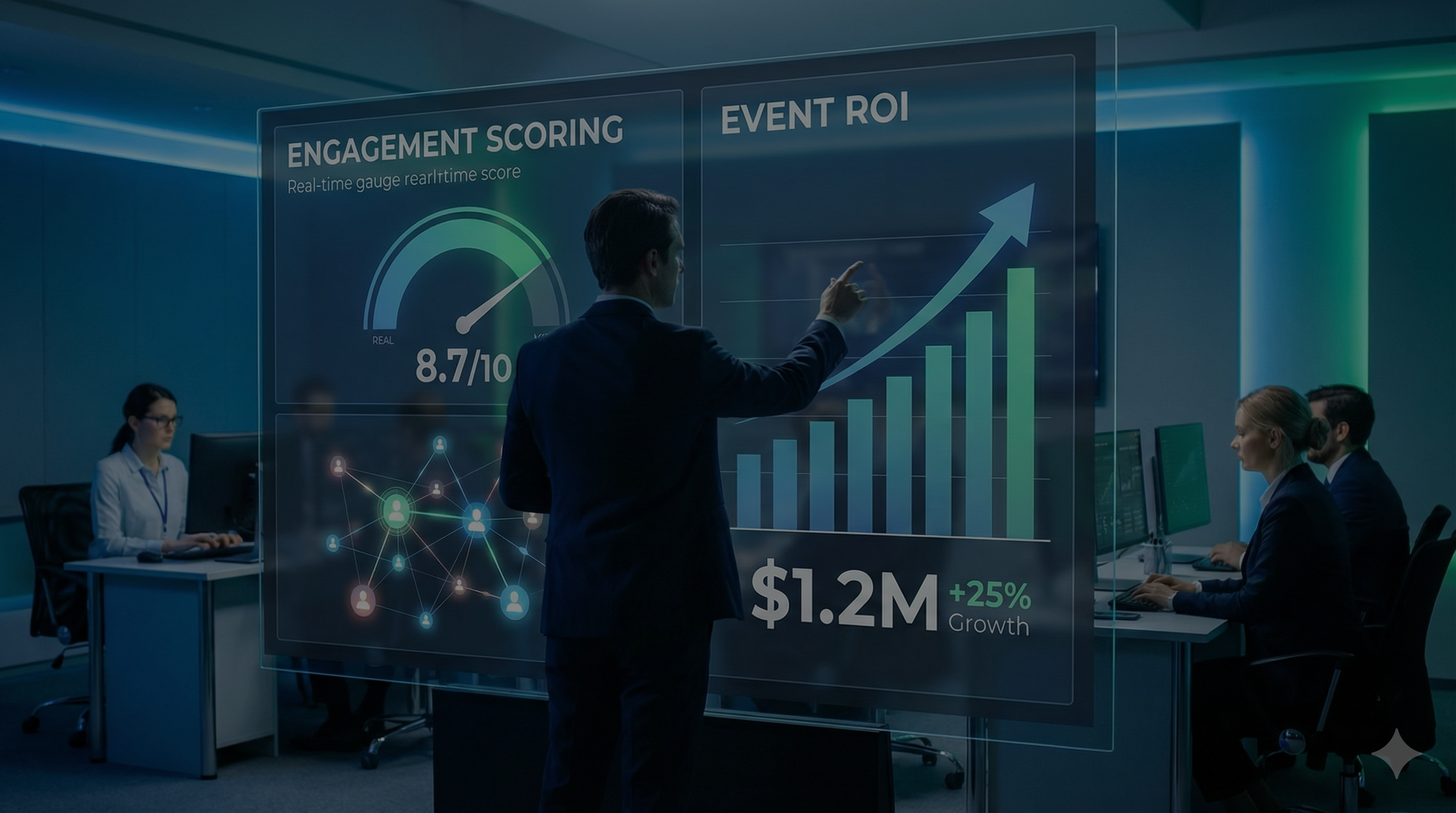
Engagement scoring turns scattered actions into a clear signal. It shows who was highly involved, what content pulled people in, which moments moved the needle, and where attention dropped. More importantly, it connects those behaviors to outcomes: qualified leads, influenced deals, satisfied members, retained employees, and sponsor value you can prove.
This is what modern event teams need: not more dashboards, but better answers. Who was truly engaged? What experiences mattered most? And how did this event perform against real business goals?
InEvent makes this possible by capturing engagement across the entire event lifecycle, before, during, and after and scoring it in one connected platform. No disconnected reports. No guessing. Just clear, usable insight you can act on.
Because when you can measure engagement properly, you stop reporting activity and start driving results.
Engagement scoring is how modern event teams turn participation into performance data. Instead of tracking individual actions (such as who registered or checked in), it assigns weighted values to behaviors across the full event lifecycle: before, during, and after the event.
Think of it like this:
A registration might be worth 1 point.
Joining a session could earn 5.
Asking a live question or booking a meeting? That’s worth more—because it signals deeper interest.
Post-event survey completion? That’s continued engagement after the event is “over.”
This creates a composite score for every attendee. Now you’re not just seeing what happened—you’re seeing who was truly engaged.
The difference between engagement counts and engagement scores matters. Counts tell you how many people clicked. Scores tell you how invested they were. It’s the difference between surface-level interest and buying intent, between showing up and taking action.
And why does that matter for ROI?
Because events are no longer standalone moments—they’re critical parts of your marketing funnel, membership experience, donor pipeline, or training journey. When you know who was most engaged, you know:
Which leads to prioritize
Which sponsors got real value
What content converted
Who’s likely to renew, return, or churn
Engagement scoring turns event activity into insights that drive revenue, retention, and long-term success. It's how top-performing teams move from anecdotal recaps to data-backed decisions.
Understanding engagement scoring conceptually is one thing. Seeing how it actually operates inside a real event program is where the value becomes tangible.
At a practical level, engagement scoring functions as a continuous feedback loop. Every action an attendee takes is captured, evaluated, weighted, and added to a living profile that evolves over time. That profile doesn’t just summarize activity—it becomes the foundation for smarter marketing, better sales alignment, and clearer executive reporting.
Here’s what that process looks like in real terms.
First, every interaction is logged as structured data. When someone opens an event email, visits a landing page, registers, joins a session, participates in a poll, downloads a resource, chats with a speaker, or books a meeting, those actions are recorded as discrete engagement events. Instead of living in separate tools, those interactions are unified into a single attendee timeline.
Next, each interaction is scored based on business relevance. Not all engagement is equal. A passive action like opening an email carries a different signal than active participation such as submitting a question or scheduling a 1:1 meeting. Modern scoring models assign weight based on:
Intent: Does this action suggest curiosity, evaluation, or purchase readiness?
Effort: Did the attendee invest time or make a commitment?
Context: Was the action tied to a high-value session, sponsor, or product track?
Recency: Is this engagement happening now, or weeks after the event?
Over time, these signals compound. A single click doesn’t mean much. A pattern of meaningful interactions does.
That’s where engagement scoring becomes strategic rather than tactical. Instead of looking at isolated behaviors, your team sees momentum building—or stalling—at the individual, account, and audience-segment level.
This changes how teams operate.
Marketing stops treating events as one-off campaigns and begins using them as continuous demand signals. Sales stops relying on subjective lead quality and starts prioritizing based on verified behavioral intent. Leadership moves beyond surface metrics and gains visibility into which programs are influencing pipeline, retention, and revenue.
Engagement scoring becomes the connective tissue between execution and outcomes.
One of the biggest challenges with events has always been accountability. Teams know events matter, but proving how they contribute to revenue, growth, or loyalty has historically been difficult.
Engagement scoring solves that by shifting the conversation from “how many people attended” to “what changed because they attended.”
Instead of reporting activity, you report influence.
For example:
Marketing can show how engagement correlates with lead velocity, deal creation, and conversion timing.
Sales can see which interactions tend to precede meetings, demos, or closed deals.
Customer teams can identify which events increase adoption, renewal likelihood, or expansion potential.
Sponsors can see which engagements drove actual interest, not just visibility.
This is the difference between anecdotal ROI and defensible ROI.
And because engagement scoring is built on behavior rather than assumptions, it stands up to executive scrutiny. You’re no longer making claims based on attendance numbers or generic satisfaction ratings. You’re showing how specific actions influence outcomes.
That’s what turns events from cost centers into growth engines.
Most event reports are just lists: who registered, who showed up, how many sessions were attended, and what the average satisfaction score was. But what do those numbers really tell you?
Let’s break down the problem.
Just because someone checked in doesn’t mean they were paying attention—or even stayed. Traditional metrics often stop at "butts in seats," ignoring what happened during the experience.
Was the attendee passive or active? Did they visit sponsors, join polls, ask questions, or download resources? Without that layer, attendance is just a vanity metric.
You might see that 200 people joined your opening keynote. Great. But how many stayed the whole time? How many clicked away during minute 12? Who was interacting in the chat or engaging with speaker content?
Static session counts miss all this nuance. And that means teams are guessing what worked—instead of knowing.
Surveys can be useful, but response rates are usually low, answers are often generic, and they only reflect what people remember. You lose the moment-to-moment insight that helps improve events in real time.
Also, not every attendee fills out surveys—and those who do may not be representative of your audience. If you’re relying solely on surveys, you’re flying blind.
If your registration system, event app, email marketing, and CRM don’t talk to each other, you're not getting the full picture.
That means:
You can’t track engagement from first touch to follow-up
You don’t know if a sponsor booth visit led to a sale
You can't see which sessions influenced the pipeline
You miss patterns across events (e.g., top-performing content over time)
This fragmentation makes it nearly impossible to tell a cohesive story about event ROI.
Engagement isn’t just a moment. It’s a journey. And traditional tools don’t account for the before and after—just what happened on the day.
If you want to connect events to revenue, renewal, and retention, you need more than check-in data and survey scores.
You need engagement scoring that captures real behavior—and tools that help you act on it.
See how InEvent fixes this in a single platform. Book your demo today.Most event teams measure success through attendance or surface-level satisfaction scores. But events are more than one-off experiences—they are pipeline drivers, community builders, and revenue catalysts. Engagement scoring closes the gap between activity and impact. When engagement is scored correctly, you gain insights that turn events from operational tasks into strategic drivers of ROI.
Here’s how engagement scoring improves outcomes in ways that matter to marketing, sales, and leadership.
In traditional funnels, prospects move from awareness to interest to decision slowly—and often unpredictably. Engagement scoring speeds that process by surfacing intent early.
When someone:
Opens multiple event emails
Registers early and selects specific sessions
Books a 1:1 meeting
…their engagement score rises. That signals intent to marketing and sales long before a conversion form ever does.
This prevents leads from sitting idle in a database. They are pulled into relevant workflows while interest is high. Nurture campaigns can trigger automatically based on score thresholds. Sales outreach happens when behavior shows readiness—not guesswork. The result is faster pipeline movement and shorter sales cycles.
Engagement scoring helps distinguish casual attendees from high-value prospects. Simple attendance numbers can’t tell the difference between someone who logs in briefly, watches passively, or actively participates. Scoring models account for depth of involvement—polls, questions, booth interactions—so you can:
Identify leads worth sending to sales
Assign quality tiers quickly
Prioritize outreach based on real behavior, not assumptions
This shifts sales from reactive chasing to focused engagement. When teams know which leads are most likely to convert, effort turns into efficiency.
Personalization is now expected—but it doesn’t work with static lists. Engagement scores power smarter systems that tailor communication and recommendations.
For example:
A lead who engaged with product demos receives targeted post-event messaging about advanced features
Attendees who responded to specific polls get content aligned with those interests
Sponsors receive guidance on which segments to follow up with
The result is messaging that feels relevant and campaigns that perform better because they respect each attendee’s context.
Sponsors invest for outcomes, not just exposure. Visibility alone isn’t value—engagement is.
Engagement scoring connects sponsor interactions to concrete signals:
Frequency and depth of booth visits
Time spent with sponsor content
Meetings booked with sponsor representatives
Survey responses tied to sponsor offerings
ROI is no longer a vague “impressions” metric. It becomes a behavior-based score. That makes renewals easier and pricing stronger—because it’s backed by data.
Impact doesn’t always happen immediately. Many audiences engage across multiple events, sessions, or touchpoints before converting, renewing, or increasing lifetime value.
Engagement scoring allows you to:
Identify patterns that signal loyalty
Detect churn risk when engagement declines
Reward high-engagement segments with VIP experiences
You stop evaluating events in isolation and start understanding the engagement patterns that drive long-term growth.
Bottom line: Engagement scoring transforms event data into strategic signals. It enables your organization not just to report, but to predict and act. That’s how events evolve from nice-to-have experiences into measurable business engines.
If your post-event dashboard stops at “total attendance,” you’re only seeing the surface. Modern event analytics go deeper—showing not just who showed up, but how they engaged and why that matters for revenue, retention, and performance.
Here are the analytics every event leader should expect.
Heat maps visualize activity across your entire event ecosystem.
They answer questions like:
Which sessions generated the most interaction?
Where did attendees drop off?
Which booths or networking areas were most active?
Instead of static attendance counts, you gain clear visibility into behavior patterns. This helps you optimize agenda design, room usage, and content flow for future events.
Not all sessions deliver the same impact. Propensity models reveal:
Which topics drive the highest engagement
Which speakers generate the most participation
Who is most likely to attend related sessions
By analyzing session behavior, you uncover preference patterns rather than simple headcounts. These insights inform content strategy and help shape future programming around what your audience actually wants.
Raw totals don’t show which segments matter most.
Cohort analytics group attendees by:
Persona (prospect, customer, partner)
Source (email, social, referral)
Registration behavior (early bird vs last-minute)
Engagement intensity
This lets you compare how different segments behave and tailor follow-up accordingly.
For example:
Prospects who attend demos may require a different nurture path than those who only join keynotes
Alumni with sustained engagement can be invited into loyalty or advocacy programs
Cohort analysis transforms broad metrics into actionable audience intelligence.
Traditional analytics stop at “attended or not.” Modern analytics follow the entire journey:
Landing page clicks and conversions
Registration behavior and form engagement
In-event actions (sessions, chats, polls)
Post-event follow-ups and conversions
CRM impact (pipeline movement, revenue influence)
You can clearly see how in-event behavior connects to downstream business results. That’s true attribution.
Correlation analytics ask a simple but powerful question: which actions predict outcomes?
For example:
Do attendees who participate in Q&A convert at higher rates?
Does visiting multiple sponsor booths correlate with larger deal sizes?
Are certain session tracks linked to stronger retention?
This level of insight aligns event performance with organizational KPIs, giving leadership clarity on where to invest and what to improve.
Analytics should do more than report—they should drive action.
The best systems let you:
Trigger automated follow-ups based on behavior thresholds
Surface high-intent leads directly in your CRM
Personalize content using audience signals
Alert sales or customer teams when engagement hits key benchmarks
This turns analytics from a rearview mirror into a real-time steering wheel.
Engagement patterns, behavioral segments, journey flows, and predictive correlations are the signals that guide smarter decisions. When you can connect what people do to what should happen next, you’re not just measuring—you’re optimizing.

Engagement scoring and attribution are powerful on their own. But they become truly strategic when that data flows into the systems your team already uses. That’s why integration matters. Real integration connects your stack instead of creating new data silos.
Here’s how modern platforms should handle engagement data—and how InEvent delivers actionable connectivity across your ecosystem.
Your CRM is the system of record for leads, opportunities, and revenue. Event engagement should live there too.
With InEvent’s native integrations with Salesforce and HubSpot, you can:
Sync event registrations and attendance to CRM records
Push engagement scores and behavioral data into contact profiles
Update opportunity influence and pipeline stages in real time
Sales teams don’t just see that someone attended—they see what they actually did. That insight makes follow-ups more relevant and deals easier to prioritize.
Microsoft Dynamics is also supported, giving organizations on that ecosystem a unified view of event and customer engagement.
Engagement data should drive your nurture and retargeting—not sit in a separate system. Your marketing automation platform should respond to what attendees do, not just what they signed up for.
With InEvent integrations:
Registrations, engagement scores, and session activity sync into Marketo or Pardot
Audience segments update automatically based on behavior
Campaigns trigger from engagement thresholds (such as sending follow-ups or targeted offers)
This ensures the right message reaches the right person at the right time—based on real interaction, not manual list uploads.
Sometimes leadership, operations, or RevOps teams need deeper analysis than built-in dashboards provide.
InEvent integrates with:
Google Analytics for behavioral tracking and channel performance
Tableau and Power BI for advanced reporting and executive visualization
Segment or Fivetran to route event data into data warehouses or CDPs
This allows you to combine event engagement with web activity, campaign performance, and financial data for a complete business view. Event metrics stop living in isolation and become part of your enterprise intelligence.
Engagement doesn’t only happen online. In-person interactions are just as important.
InEvent captures:
Mobile app activity
Check-ins and session scans
Booth visits and networking interactions
These onsite signals feed directly into engagement scores and sync with your CRM and analytics tools. The result is a unified journey—from event floor to executive reporting.
When engagement and attribution live inside your CRM, you unlock revenue insights that were previously invisible:
Identify which behaviors influence deal progression
Track pipeline directly impacted by events
Compare event ROI against other marketing programs
With automated data flows, revenue impact isn’t estimated—it’s visible.
Modern engagement scoring only reaches its full value when data moves seamlessly to the people and systems that need it. InEvent’s deep integrations let you act on engagement in real time, make your reporting defensible, and align events directly with revenue goals.
You may be wondering how InEvent fits into your day-to-day work. Here are practical ways teams use engagement scoring across different scenarios.
You’re running a three-day conference with hundreds of attendees. Some stop by your booth. Others attend your sessions. Some download your whitepaper. But how do you know who is actually ready for sales?
With engagement scoring, your team can filter by booth visits, session duration, and content interactions. Suddenly, you’re not just handing over leads—you’re passing along qualified interest. SDRs can follow up the next day with real context: “I saw you spent time at our AI panel—want to go deeper?”
Sponsors want more than logo placement—they want measurable ROI. Engagement scoring lets you provide concrete data: how many attendees visited their page, downloaded a brochure, asked a question, or bookmarked their brand.
You move beyond “foot traffic” and show how sponsors actually influence the buyer journey.
Members may register for events, but who is truly engaged over time? Associations use scoring to track not just attendance, but participation across webinars, surveys, volunteer programs, and chapter events.
This gives member success teams early signals to reduce churn and helps marketing teams target campaigns to the right segments.
Not every event is external. For internal communications teams, scoring reveals how employees interact with leadership town halls, DEI sessions, and product updates.
Are certain departments more engaged? Are replay views dropping off? Engagement scoring shows what resonates—and what doesn’t.
You run quarterly webinar programs. Engagement scoring connects the dots: who consistently attends, who clicks follow-ups, and who converts within 30 days.
Instead of treating webinars as isolated events, your marketing team sees them as a continuous conversion journey.
It’s time to move beyond attendance counts. If you’re still measuring success by who shows up, you’re missing the deeper story. Real engagement happens in every question asked, every click tracked, every moment someone leans in.
InEvent gives you the tools to capture it all and turn it into business results.
From smarter lead scoring to better stakeholder reports, from faster follow-ups to stronger sponsor ROI—engagement scoring transforms your events into growth engines.
Let’s show you how it works.
1. What is engagement scoring?
Engagement scoring assigns values to attendee actions across the entire event journey—from registration to booth visits to post-event surveys. It helps you understand interest levels, segment your audience, and trigger smarter follow-ups.
2. How is engagement tied to revenue?
Highly engaged attendees convert faster and more often. By scoring behaviors, you can connect event interactions to real revenue outcomes. This is how marketing and sales teams prioritize high-intent leads and demonstrate the true impact of events.
3. Can I customize scoring models?
Yes. InEvent allows you to define which actions matter most—such as session attendance, downloads, or chats—and assign different weights based on your objectives. You can create custom models for different event types or audience segments.
4. Does this work for both virtual and in-person events?
Absolutely. InEvent captures engagement across all formats—virtual, hybrid, and in-person—so you get a complete picture of attendee behavior, whether they’re logging in or attending on-site.
5. How do I report ROI to stakeholders?
InEvent’s dashboards display engagement scores, conversion trends, and revenue attribution in real time. You can export reports for leadership or sync data directly with your CRM or BI tools for deeper analysis.