


One of our sales representatives will contact you shortly.
Embassies don't run "events."
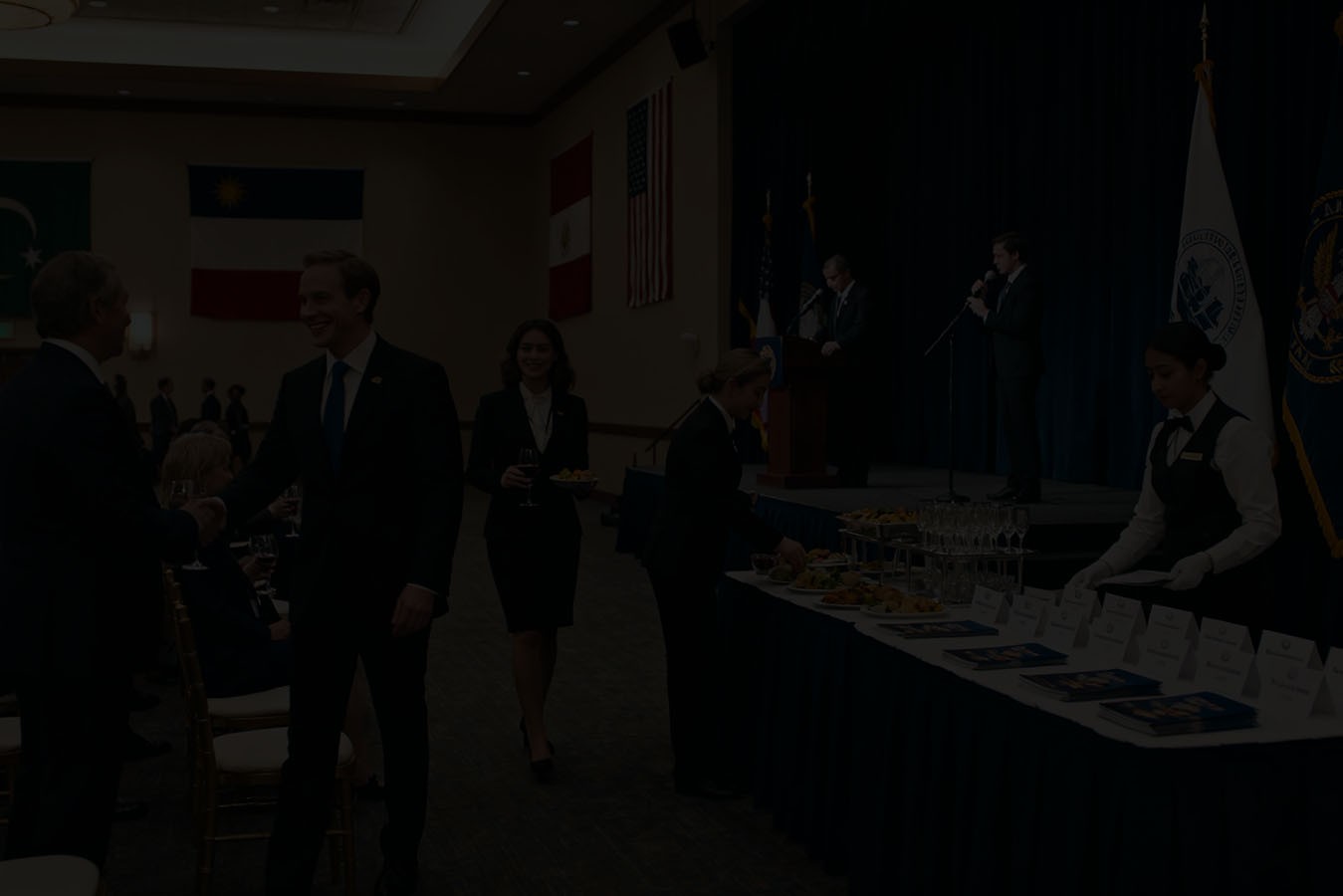
They run diplomatic receptions where a guest list mistake becomes front-page news in two countries. They run national day celebrations where 400 guests from 30 different nations need registration, communications, and onsite signage — each in their own language. They run classified briefings where a leaked document isn't just embarrassing. It's a security breach with real geopolitical consequences.
And somehow, most embassies still manage all of this with spreadsheets, email chains, and event platforms that were built for corporate conferences — not diplomatic operations.
That's the gap embassy event management software is built to close.
If you work at an embassy, consulate, high commission, or permanent mission, you already know the challenge. Your team is small. Your budget is tight. Your events range from intimate 20-person classified briefings to 500-guest national day celebrations. And the software you're using right now probably can't handle half of what you need it to do.
This page is for you. Whether you're a social secretary managing seating charts and protocol, a cultural attaché organizing film screenings and art exhibitions, or a consular officer running visa workshops for hundreds of citizens — we're going to walk through exactly what embassy event management software should do, what most platforms get wrong, and how InEvent fills the gaps that generic tools can't.
InEvent works with government agencies including NASA, the U.S. Department of Commerce, the SEC, and the FDIC. The platform holds a U.S. Government Authorization to Operate, is FAR-compliant, NDAA Section 889 compliant, and runs on Microsoft Azure infrastructure with data centers in Virginia (US) and Dublin (EU). It supports 180+ languages.
That's not a sales pitch. That's the baseline you should expect from any platform handling diplomatic data.
Here's the thing most event software companies don't understand about embassies: your problems aren't just "enterprise problems with extra steps." They're fundamentally different.
Let's break down the five specific ways generic platforms fail diplomatic operations.
When Eventbrite says "private event," they mean a password-protected page. When an embassy says "private event," they mean a guest list curated by diplomatic staff, sometimes cleared by security services, where every single name is individually vetted before confirmation.
Embassy events need invite-only registration with approval workflows. You need the ability to flag, block, or conditionally approve individuals. Vendors, catering staff, and support personnel all need separate clearance levels. A public registration page — even a "private" one — is a non-starter.
As RSVPify pointed out in their guide to embassy events, "admitting guests to an embassy event is somewhat similar to crossing a border." That's not an exaggeration. And most event platforms have no concept of border-level guest control.
A national day celebration at the French Embassy in Washington might have guests from 30+ countries. The registration form needs to work in French, English, Arabic, Spanish, Mandarin — and not just the form. The confirmation email. The agenda. The mobile app. The onsite signage. The dietary preference survey. The post-event thank-you note.
That's what real multilingual event management looks like. Not a language toggle on the homepage. The entire attendee journey, from first invitation to post-event survey, needs to work in the guest's own language — automatically.
The Australian Embassy's Social Secretary manages seating charts "in accordance with cultural and protocol requirements." This isn't a preference. It's a job requirement.
Diplomatic precedence determines who sits where, who enters the room first, who is greeted before whom. VIP handling isn't "nice to have." Delegation management isn't an add-on. Tiered access levels — Ambassador level, Minister level, Diplomatic Corps, Business, Press, General — are operational requirements that your event software either supports natively or doesn't.
Most event platforms have no concept of diplomatic tiering. And the workarounds (custom fields, manual tagging, separate registration pages) fall apart the moment you have 400 guests and three days to pull it together.
Here's where it gets legally complicated.
A European embassy in Washington needs GDPR compliance for EU citizen data — even though the event happens on American soil. A Japanese embassy in London needs to comply with Japan's APPI (Act on the Protection of Personal Information) for its citizen data, while also respecting UK data protection rules for local guests.
Embassy data often falls under the home country's data protection regime, not the host country's. Where your event software stores data, who has access to it, how it's processed — these aren't IT preferences. They're legal requirements that can create real problems if your platform can't accommodate them.
This is the one nobody talks about.
Many embassy buildings operate on restricted or classified WiFi networks that guest devices cannot access. Some diplomatic compounds don't have public-facing internet at all. Military attaché offices, SCIFs (Sensitive Compartmented Information Facilities), and secure wings of embassy buildings are dead zones for cloud-dependent software.
If your check-in system needs persistent internet to scan badges, verify guests, and print credentials, it fails the moment guests arrive at a secure facility. And that's precisely the environment where getting check-in right matters most.
InEvent's offline check-in with local server sync was built for exactly this scenario. Attendee data caches locally on the check-in devices. Staff continue scanning, verifying, and printing badges from that cached data — no internet required. When connectivity restores, data syncs automatically. No data loss. No operational gaps.
It's the feature most embassy event teams don't know they need until the morning of a 400-person national day reception when the venue WiFi collapses.
Every embassy is different. But the events they run tend to fall into seven categories — and each one has specific software requirements that generic platforms struggle with.
1. National Day Celebrations
The flagship annual event. Typically 300 to 600 guests, multiple nationalities, formal protocol, cultural performances, speeches, and the national anthem. Often held at the ambassador's residence or a rented external venue.
What the software needs to do: Branded multi-language registration. VIP tiering across at least four or five guest categories (Ambassador-level, Diplomatic Corps, Business, Media, General). Dietary and cultural accommodation tracking (not just "vegetarian or not" — kosher, halal, specific allergens, cultural food requirements). Protocol-aware seating. On-demand badge printing with guest tier visible on the badge. Post-event reporting for the ambassador's annual review.
2. Diplomatic Receptions and State Dinners
Smaller than national day celebrations (typically 50 to 150 guests), but the stakes are significantly higher. These are invite-only events that may involve heads of state or senior cabinet ministers.
What the software needs to do: Approval workflows for every single attendee. Secure document sharing for pre-event briefing materials and protocol guides. Closed guest lists with zero public-facing registration. Protocol seating management that accounts for diplomatic rank. NFC or facial recognition check-in for VIP verification at the door.
3. Consular and Citizen Service Events
Visa information sessions, passport renewal days, emergency citizen briefings, voting-abroad workshops. These are public-facing — any citizen of the home country can attend.
What the software needs to do: High-volume registration with identity verification. Appointment scheduling integration so citizens can book specific time slots. Multilingual communications in both the home country's language and the local language. Accessibility compliance (WCAG-AA). Walk-in registration capability for citizens who show up without pre-registering.
4. Trade and Business Delegations
Embassy-facilitated events that connect home-country businesses with host-country partners. Often co-organized with trade ministries, chambers of commerce, or economic development agencies.
What the software needs to do: Attendee matchmaking based on industry, interests, and meeting objectives. AI-powered meeting scheduling. Lead capture and exhibitor management. CRM integration (Salesforce, HubSpot, Dynamics 365) so the trade office can track follow-up activity. Sponsor and exhibitor booth management. Post-event ROI reporting showing which connections actually turned into business.
5. Cultural and Educational Programs
Art exhibitions, film screenings, lecture series, language classes, student exchange orientation, cultural festivals. Think Passport DC, where 170+ embassies open their doors to the public every May in Washington.
What the software needs to do: Recurring event templates (film screening every Tuesday is a different event from a one-time gala). Series management with unified attendee databases across events. Community building tools to keep cultural program attendees engaged between events. Media and press registration with separate credentialing. Public ticketing with capacity controls.
6. Classified Briefings and Closed-Door Sessions
Intelligence briefings, security assessments, diplomatic negotiations, sensitive policy discussions. Zero public access. Sometimes zero written record of attendees.
What the software needs to do: Maximum-security registration with multi-factor identity verification. No cloud dependency — the system must work offline so no data leaves the local device until authorized. Secure document sharing with access expiration and download controls. Complete audit trail of who accessed what documents and when. No recording or streaming capabilities active during the session.
7. Visiting Delegation and VIP Programs
When the home country sends a minister, trade delegation, or parliamentary committee to visit the host country. Multi-day itineraries across multiple venues.The point here isn't that every embassy runs all seven types. It's that your event software needs to handle whichever combination you do run — without forcing you to use a different platform for each one.
If you're evaluating embassy event management software, this is the section to bookmark. These aren't nice-to-haves. They're requirements.
Attendee data, guest lists, briefing documents, check-in records, post-event analytics. All of it needs to be encrypted at rest and in transit. Not just the registration form. The entire data lifecycle.
InEvent encrypts all data using AES-256 and holds SOC 2 Type II certification — which means their security controls have been independently audited over a sustained period, not just at a single point in time.
Here's the full stack you should be looking for: SOC 2 Type II, GDPR, HIPAA, PCI DSS, and WCAG-AA for accessibility. For U.S. government embassies specifically, you also need FAR (Federal Acquisition Regulation) compliance and NDAA Section 889 compliance.
InEvent holds all of these. For context: Bizzabo has SOC 2 and GDPR. Cvent has SOC 2 and GDPR. Lyyti emphasizes GDPR heavily (they're a Finnish company). None of them have FAR or NDAA compliance because they don't serve the U.S. federal procurement market at the depth InEvent does.
InEvent runs on Microsoft Azure with data centers in Virginia (US) and Dublin (EU). Embassies can choose which region their data resides in based on their home country's data sovereignty requirements. For EU embassies, GDPR mandates that EU citizen data stays within EU-approved jurisdictions. For embassies of countries with strict data localization laws (Russia, China, India, Brazil), data residency options matter enormously.
The cultural attaché planning a film screening should not have access to the security team's cleared guest list for a classified briefing. This sounds obvious, but many event platforms only offer two or three permission levels — typically "admin," "editor," and "viewer."
InEvent supports 25+ permission levels with both company-level and event-level scoping. That means you can give your social secretary full control over the national day celebration while keeping the defense attaché's classified briefing completely invisible to anyone outside the security team.
Embassy staff already authenticate through their government's identity provider — Azure AD, Okta, SAML 2.0, or LDAP. Your event software must integrate into that existing authentication chain. Creating another password to manage is creating another attack surface to defend. And in a diplomatic environment, every additional credential is a potential vulnerability.
Now let's get specific. Here's how InEvent's capabilities map to the real scenarios embassy teams face every week.
InEvent auto-detects the attendee's browser or app language and displays content accordingly. Registration forms, confirmation emails, agendas, speaker bios, sponsor profiles — all translatable. Google Translate AI integration enables fast auto-translation across all event touchpoints, with manual override for diplomatic precision when machine translation isn't good enough.
The platform supports four primary interface languages (English, French, Spanish, German) with 180+ content languages. For a national day celebration with guests from 30 countries, every attendee sees the event in their language — without the organizer creating 30 separate events.
Upload your curated guest list. Send branded invitations through the platform. Each registration requires individual approval before confirmation. No one gets in without being vetted. Tier guests into categories and deliver different content, communications, and access levels to each tier. For consular events, switch to public registration with walk-in capability.
This is InEvent's biggest differentiator for embassy teams.
AI facial recognition check-in, QR code scanning, or NFC tap — your choice depending on security level. On-demand badge printing with Zebra printers (ZD200, ZD400, ZD600 series) supports plastic, paper, and PVC credentials. Drag-and-drop badge designer lets you create badges that display guest tier, dietary requirements, or access zones. Self-service iPad kiosks work for high-volume consular events where hundreds of citizens need to check in quickly.
And critically, all of this works offline. When embassy WiFi is restricted or unavailable, InEvent's local device sync caches attendee data on the check-in device. Badge printing continues from cache. Attendee verification continues from cache. When connectivity restores, everything syncs back automatically. No data loss. No line of frustrated guests at the door wondering why the system stopped working.
No other major event platform offers this. Lyyti doesn't. Cvent doesn't. Bizzabo doesn't.
White-label app carrying the embassy's branding — not InEvent's. The app includes the event agenda, speaker profiles, networking tools, push notifications, venue maps, and document sharing. It works offline for restricted-network venues, so guests can check the agenda and access documents even when they can't connect to WiFi.
For visiting delegations, InEvent integrates with travel systems (Amadeus, Sabre) for flight tracking, supports hotel room list management, meal vouchers, and ground transportation coordination. The embassy protocol team manages the entire delegation journey from one dashboard instead of coordinating across five spreadsheets and three email threads.
InEvent's AI tools help embassy teams work faster with smaller staff. ChatGPT integration (via Azure OpenAI Service) helps draft invitation copy, speaker bios, and post-event reports in multiple languages. AI matchmaking connects trade delegation attendees based on industry and meeting objectives. AI-powered agenda builder generates session frameworks from a theme brief. Real-time AI audio transcription serves both as an accessibility feature and as a practical tool for multilingual diplomatic events.
Check-in rates, session attendance, engagement metrics, networking activity, and sponsor interaction data. All exportable for the ambassador's annual review or for trade delegation ROI measurement. Integrates with CRMs (Salesforce, HubSpot, Dynamics 365) for follow-up pipeline tracking after trade and business events.
Let's be honest about the alternatives. If you're evaluating embassy event management software, you're probably looking at three or four options. Here's where each one actually stands.
1. Lyyti
Lyyti is the only platform besides InEvent with explicit embassy positioning. They claim 250+ diplomatic entities using their platform, and that's a real number worth respecting. They're strong on GDPR compliance (they're Finnish, so GDPR is in their DNA) and they handle straightforward registration and communication workflows well.
Where Lyyti falls short is in onsite operations. No badge printing hardware integration. No NFC or RFID check-in. No offline capability. No AI tools. No travel management. If your embassy events are primarily registration-and-email — invitation, RSVP, confirmation, thank you, Lyyti handles that competently. If you run national day celebrations with 400+ guests needing badge printing, protocol seating, multilingual onsite operations, and offline check-in in a restricted-network venue, Lyyti doesn't have the tools.
2. Cvent
Enterprise-grade platform with the largest venue sourcing network in the industry. Strong CRM integrations, especially with Salesforce and Marketo. Used by some government agencies.
But Cvent has no embassy-specific workflows. No diplomatic protocol features. No offline check-in architecture. And the pricing is complex — it can surprise smaller embassy teams who don't realize how quickly add-ons stack. Onboarding typically takes months, not weeks. If you're part of a large government procurement system already using Cvent across dozens of agencies, it might make sense for standardization. For a standalone embassy team running 30 events per year, it's overkill in some areas and underbuilt in the areas that matter most to diplomatic operations.
3. Eventbrite and other generic registration tools
Fine for public cultural events and ticketed film screenings. No invite-only approval workflows. No security clearance integration. No multilingual depth beyond basic page translation. No onsite badge printing. No data residency controls. Using Eventbrite for a classified diplomatic reception is like using a bicycle for a presidential motorcade. Technically transportation. Practically inadequate.
4. InEvent
Enterprise security stack (SOC 2 Type II, GDPR, HIPAA, FAR, NDAA) combined with diplomatic-ready features: 180+ languages with auto-detection, invite-only approval workflows, VIP tiering, offline check-in for restricted venues, Zebra badge printing, 10+ AI tools, travel management, and a branded mobile app. Microsoft Azure infrastructure with US and EU data residency options. A dedicated project manager for every enterprise client — not a chatbot, a human being who knows your events.
The gap InEvent fills is specific: enterprise-grade compliance and onsite operations, plus the multilingual, protocol-aware workflows that embassies specifically need. It's the combination that no other single platform delivers.
Deploying new software in a diplomatic environment isn't like signing up for a SaaS trial. There's a compliance review, a configuration phase, and a pilot before anyone goes live with a flagship event. Here's what the process actually looks like.
Step 1: Security review and compliance check
InEvent's security team works with your embassy's IT and compliance officers to complete security questionnaires, review data processing agreements, and confirm data residency requirements. SOC 2 Type II report, GDPR Data Processing Agreement, and full compliance documentation are available under NDA for procurement review.
Step 2: Platform configuration
Your dedicated project manager configures the platform to your embassy's brand — logo, colors, national insignia. Permission levels get set up for your team structure (Social Secretary, Cultural Attaché, Consular Operations, Security, IT). Language settings get configured for your primary operating languages. Event templates get built for your most common event types so you're not starting from scratch every time.
Step 3: Pilot event
Run one event — a smaller cultural program, an internal reception, or a consular service day — on the platform before your flagship national day celebration. Test registration workflows, check-in processes, badge printing, and mobile app distribution. Your PM walks you through the entire dry run and helps troubleshoot anything that comes up.
Step 4: Full deployment
Roll out across your full events calendar. InEvent supports unlimited events on enterprise plans. Templates from your pilot event become reusable starting points for recurring programs. Support is available 24/7 across all time zones — from a human, not a chatbot.
Most embassy teams are fully operational within two to three weeks for straightforward setups. Complex deployments with multiple integrations, custom SSO configurations, and large-scale data migrations typically take four to six weeks.
Every embassy event — from a 500-person national day celebration to a 20-person classified briefing — is an extension of your country's identity and values. The software you use to manage those events should meet the same standard.
That means real security, not checkbox compliance. Real multilingual capability, not a translated homepage. Real onsite operations that work even when the WiFi doesn't. And a platform that understands diplomatic protocol isn't a nice feature — it's the whole point.
InEvent gives embassy teams the combination of enterprise security, multilingual depth, offline capability, and onsite operational tools that generic event platforms simply can't deliver. Every enterprise client gets a dedicated project manager. Every deployment starts with a security review. Every event runs on the same Microsoft Azure infrastructure that powers government operations worldwide.
Whether you're planning your next national day celebration, organizing a trade delegation visit, or setting up consular services for your citizens abroad — the conversation starts with understanding your specific requirements.
1. What security certifications should embassy event software have?
At minimum, look for SOC 2 Type II, GDPR compliance, data encryption at rest and in transit, SSO support, and role-based access control. For U.S. government embassies, you also need FAR compliance and NDAA Section 889 compliance. InEvent holds all of these, plus HIPAA, PCI DSS, and WCAG-AA certification.
2. Can embassy event software work without internet?
InEvent's offline check-in with local device sync is specifically designed for this. Attendee data caches locally. Staff continues scanning, verifying, and printing badges from cache when WiFi drops or is restricted. Data syncs automatically when connectivity is restored. This is critical for embassy buildings with restricted or classified WiFi networks where guest devices and vendor equipment can't connect.
3. How many languages does InEvent support?
180+ languages with auto-detection. The platform reads the attendee's browser or app language and displays content accordingly. Registration forms, emails, agendas, speaker bios, and the mobile app all translate. Google Translate AI integration enables fast, automatic translation with a manual override for diplomatic precision when machine translation isn't appropriate.
4. Can embassy event software handle both public citizen events and classified briefings?
Yes, through permission-based event separation. InEvent supports 25+ permission levels. A public visa workshop and a classified security briefing can run on the same platform with completely separate access controls, guest lists, and data visibility. The consular team sees their events. The security team sees theirs. No crossover unless you explicitly configure it.
5. How does InEvent compare to Lyyti for embassy events?
Lyyti is used by 250+ diplomatic entities and is strong on European GDPR compliance and straightforward registration workflows. InEvent adds full onsite operations (badge printing with Zebra printers, NFC and RFID check-in, facial recognition, offline check-in), a 10+ tool AI suite, travel and hospitality management, and a broader compliance stack (FAR, NDAA, and HIPAA in addition to SOC 2 and GDPR). For embassies with significant in-person event operations, InEvent covers capabilities that Lyyti doesn't offer.