


One of our sales representatives will contact you shortly.
Here's something that surprised me the first time I learned it.
The Inter-Parliamentary Union Assembly — the biggest gathering of legislators on the planet — brings together delegates from over 180 countries. We're talking about hundreds of parliamentarians, their staff, interpreters, security teams, journalists, and observers. All converging on one venue for multiple days of sessions, votes, debates, and networking.
And the technology stack behind most of these events? Spreadsheets. Email chains. Paper credential checks at the door. Maybe a shared Google Doc for the agenda if someone's feeling fancy.
It sounds absurd when you say it out loud. These are the institutions that write laws governing billions of people. They have sophisticated systems for drafting legislation, recording votes, and publishing official records. But when it comes to the operational side — who's registered, who has credentials, who's queued to speak at a hearing, how delegates from 40 countries access the agenda in their own language — most parliaments are running on duct tape and good intentions.
That's the gap parliamentary session software is built to close. And it's a bigger gap than most people realize.
In this guide, we're going to walk through what parliaments actually need from event management technology, why the tools they already have don't cover it, and how InEvent fills the space between legislative process software and the real-world logistics of running parliamentary events.
Whether you're a clerk managing committee hearings, an IT director modernizing a legislative assembly, or an administrative officer organizing an inter-parliamentary conference — this is for you.
Let's start with something that gets overlooked constantly.
When people think about parliamentary technology, they think about the lawmaking process. Bill drafting. Electronic voting. Hansard transcription. Statute codification. And those systems exist — companies like Parliament.io, SBL eParliament, and EY's Legislative Management Suite have built excellent tools for the legislative workflow itself.
But parliaments also run events. Lots of them. Every single session.
State opening ceremonies where the head of state addresses parliament in front of diplomatic guests, Supreme Court justices, military leadership, and international media. Committee hearings where members of the public register to give testimony, queue up to speak, and submit written evidence. Inter-parliamentary conferences where delegates from dozens of countries need registration, credentials, multilingual agendas, and onsite logistics. Press conferences where only credentialed journalists are allowed through the door. Public gallery visits where citizens register online to watch plenary debates from the viewing gallery.
Every single one of these is an event management challenge. And here's the thing — the e-Parliament tools that handle bill drafting and voting were never designed to manage any of it.
They don't handle visitor registration. They don't print credentials. They don't manage speaker queues for public hearings. They can't coordinate multilingual communications for 500 delegates from 40 countries. They don't offer a mobile app for navigating a multi-day conference agenda. They don't do hybrid participation so a witness can testify remotely while others appear in person.
That's not a criticism. Those tools were built to solve legislative workflow problems, and they solve them well. But there's an entire operational layer sitting on top of the legislative process — the who enters the building, who gets a badge, who speaks when, how does the public participate layer — that nobody's built technology for.
Until now.
InEvent bridges that gap. It's enterprise event management infrastructure — registration, credentialing, check-in, mobile apps, hybrid streaming, AI tools, analytics — mapped specifically to the requirements of legislative environments. It doesn't replace your e-Parliament system. It handles everything your e-Parliament system was never meant to do.
And InEvent comes with the government compliance credentials to back it up: FAR compliance, NDAA Section 889 compliance, a U.S. Government Authorization to Operate, SOC 2 Type II certification, and Microsoft Azure infrastructure with data centers in Virginia and Dublin. It's the same platform used by NASA, the U.S. Department of Commerce, the SEC, and the FDIC.
Three forces are converging that make parliamentary event management technology urgently necessary. And if you work in a legislative environment, you're probably already feeling all three.
COVID proved that remote participation in legislative proceedings works. And the genie isn't going back in the bottle. The European Parliament holds sessions in both Strasbourg and Brussels with remote participation options. The UK Parliament experimented with hybrid proceedings. Dozens of national and state legislatures now allow remote committee testimony, virtual public hearings, and hybrid session participation.
But here's the problem: "hybrid" isn't just a Teams link. When a witness testifies remotely at a committee hearing while others appear in person, you need technology that manages both audiences simultaneously — registration, speaker queuing, document sharing, recording, and engagement — in a single unified platform. That's event management infrastructure. And most parliaments are jury-rigging it with Zoom plus a spreadsheet.
Citizens expect to register for public gallery access online. They expect to watch committee hearings via livestream. They expect to submit public comments digitally. They expect confirmation emails in their own language. They expect the same seamless digital experience they get from literally every other institution they interact with.
When a parliament's public engagement interface is a phone number and a paper sign-in sheet, that's not just inconvenient. It's a transparency failure. And in an era where trust in legislative institutions is already fragile, the friction of outdated systems actively discourages civic participation.
After security incidents at legislative buildings around the world, credential management and access control aren't administrative tasks anymore. They're safety requirements. Knowing exactly who's in the building, which zones they're authorized to access, and whether their credentials are current — in real time — is no longer optional.
Paper visitor logs and manual ID checks don't cut it. You need digital credentialing with tiered access, real-time check-in tracking, and the ability to instantly verify who's authorized to be where. That's what parliamentary session software provides.

Every parliament is different. Different procedures, different traditions, different scales. But the events they run tend to fall into six categories — and each one has specific operational requirements that generic tools struggle with.
I'm going to walk through each one, because understanding the diversity of parliamentary events is the first step toward understanding why you need purpose-built technology.
1. Plenary Session Operations
Not the voting or the debate itself — that's what chamber hardware and e-Parliament systems handle. We're talking about everything around it. Public gallery registration and access management. Press gallery credentialing. Visitor screening and security coordination. Staff and contractor credential verification. Real-time session streaming for citizens watching from home. Translation and interpretation coordination for multilingual legislatures.
For a typical plenary day in a bicameral parliament, you might have 200+ public gallery visitors, 50+ credentialed journalists, hundreds of staff members, security personnel, and support contractors — all needing different levels of access, different credentials, and different information. That's an event operations challenge.
2. Committee Hearings with Public Witnesses
This is where parliamentary event management gets genuinely complex.
Witnesses need to register in advance. They need to be queued in a speaker order that the committee chair manages in real time. Some witnesses appear in person. Others testify remotely via video. Written testimony needs to be submitted and distributed to committee members before the hearing starts. Time allocation needs to be tracked so each witness gets their fair share. Audio and video need to be recorded with automatic timestamping so the official record can reference specific moments. Public observers need to register separately. And all of it needs to be published afterward for transparency.
Most parliaments handle this with a combination of email, phone calls, and manual coordination. It works — the way carrying groceries without bags works. Technically possible. Unnecessarily painful.
3. Inter-Parliamentary Conferences and Assemblies
These are the big ones. The IPU Assembly with delegates from 180+ countries. The Commonwealth Parliamentary Association conferences. Regional legislative summits. Cross-border parliamentary committees.
Multi-day, multi-track events with hundreds of delegates who need registration, credential printing, multi-language agendas, delegation management (the Japanese delegation has different needs than the Brazilian delegation), travel and hospitality coordination (flights, hotels, ground transport, per-diems), a mobile app that works in their language, and onsite check-in with badge printing.
This is enterprise conference management. And it's happening inside some of the most security-conscious buildings on the planet.
4. State Opening Ceremonies and Special Sessions
High-protocol events that look a lot like what embassies run for national day celebrations. Guest lists curated at the highest level. Heads of state, diplomatic corps, Supreme Court justices, military leadership, religious leaders — each with specific protocol requirements for seating, entry order, and greeting sequence.
VIP tiering, security-cleared credentialing, restricted media access zones, and the kind of "if we get this wrong, it becomes a news story" pressure that demands reliable technology over manual processes.
If you've read our guide to embassy event management software, you'll recognize the overlap. Diplomatic protocol events and state parliamentary ceremonies share the same operational DNA.
5. Parliamentary Press Conferences and Media Events
Credentialed journalists only. Media registration with outlet verification — you need to confirm that someone who claims to represent Reuters actually does. Press pool management for events with limited media access. Embargoed document distribution through secure channels where documents can be viewed but not downloaded until a specific time. Live broadcast coordination. Post-conference material distribution.
The security of information flow here matters enormously. When a parliamentary committee releases findings under embargo, the technology managing that distribution needs to be airtight. InEvent's secure document sharing supports access expiration, download controls, and full audit trails of who viewed what and when.
6. Public Engagement and Civic Education Programs
School visits. Public tours. Civic education workshops. Constituency days where MPs meet residents. Youth parliament simulations where students role-play legislative proceedings. Open days where the public explores the parliament building.
These are high-volume, public-facing events that need simple online registration, accessibility compliance (WCAG-AA), multilingual support, walk-in capability for people who show up without registering, and certificate of attendance generation for educational programs.
They're also the events where parliamentary event management software has the biggest impact on public trust. When a citizen's first experience with their parliament is a smooth, professional digital interaction — register online, get a confirmation, arrive to a quick check-in — that shapes how they feel about the institution itself.
Parliamentary buildings are government security zones. The technology you use inside them needs to meet government standards. Here's the non-negotiable checklist.
MPs. Parliamentary staff. Committee witnesses. Press gallery journalists. Public gallery visitors. Diplomatic guests. Maintenance and vendor staff. Each needs different credentials with different access levels. InEvent supports tiered credentialing with on-demand badge printing through Zebra printers (ZD200, ZD400, ZD600 series), NFC/RFID tap access, and facial recognition check-in. A drag-and-drop badge designer lets you create credentials that display access zone, delegate tier, and photo ID.
This is the feature most people don't think about until they need it desperately.
Parliamentary buildings — especially chambers, committee rooms, and secure wings — often have restricted WiFi. Guest devices can't connect to the parliamentary network. In some buildings, mobile signal drops entirely in certain areas.
If your check-in system needs persistent internet to verify credentials and print badges, it fails the moment it's needed most. InEvent's offline check-in with local device sync caches attendee data on the check-in device. Staff continue scanning, verifying, and printing badges from that cache — no internet required. When connectivity restores, everything syncs automatically. No data loss. No line of frustrated delegates at the door wondering why the system stopped working.
No other major event platform offers this. Not Cvent. Not Bizzabo. Not EventsAir.
SOC 2 Type II (independently audited security controls). GDPR compliance. HIPAA. FAR (Federal Acquisition Regulation) compliance. NDAA Section 889 compliance. WCAG-AA accessibility. PCI DSS for payment processing. Role-based access control with 25+ permission levels at both company and event level. Single sign-on via Azure AD, Okta, SAML 2.0, or LDAP. Data residency options with Microsoft Azure data centers in Virginia (US) and Dublin (EU).
Why does this matter for parliamentary procurement? Because parliaments are government entities. They follow government procurement rules. FAR compliance, NDAA compliance, and a U.S. Government Authorization to Operate aren't competitive advantages — they're procurement prerequisites. And most event management platforms can't meet them
Now let's get into the specific capabilities and how they map to the real scenarios parliamentary teams face.
InEvent's polling feature supports real-time voting within sessions — anonymous or attributed, single-choice or multi-choice, with live results display or results hidden until the poll closes.
Let me be clear about what this is and isn't. For official legislative votes — recorded divisions on legislation, roll-call votes that become part of the permanent record — parliaments use dedicated electronic voting hardware built into the chamber. InEvent doesn't replace that.
What InEvent handles is everything else: committee straw polls to gauge member sentiment before formal votes. Inter-parliamentary conference resolutions where delegates from 50 countries vote on joint statements. Caucus consultations. Public engagement polls during civic events. The platform also supports Robert's Rules of Order with raise-hand functionality for structured parliamentary debate.
It's the voting and polling layer that exists around the formal legislative process — and it's the layer most parliaments currently have no technology for at all.
This is where InEvent solves one of the most painful operational problems in parliamentary events.
Delegates, witnesses, or members of the public request to speak through the mobile app or an onsite kiosk. Requests queue automatically. The clerk or presiding officer sees the queue in real time and manages it — approving, reordering, declining, or allocating specific time blocks to each speaker.
For committee hearings with public testimony, this transforms the process. Instead of staff manually tracking who's next, fielding phone calls from witnesses asking about their slot, and the chair shuffling paper cards, the entire queue is visible, manageable, and transparent. Remote witnesses joining by video are managed in the same queue as in-person witnesses. The chair allocates time. The system tracks it. The hearing runs on schedule.
This alone is worth the conversation with InEvent's team.
Inter-parliamentary conferences with delegates from 50+ countries need every touchpoint in the delegate's own language. Registration forms. Confirmation emails. Session agendas. Speaker bios. The mobile app interface. Document titles and descriptions.
InEvent's multi-language platform auto-detects the delegate's browser or app language and displays content accordingly. Google Translate AI integration enables fast auto-translation with manual override for legislative precision — because some parliamentary terminology needs a human translator, not a machine.
The platform supports four primary interface languages (English, French, Spanish, German) with 180+ content languages. For an inter-parliamentary assembly with delegates from 40 countries, every delegate sees the event in their language without the organizing team creating 40 separate events.
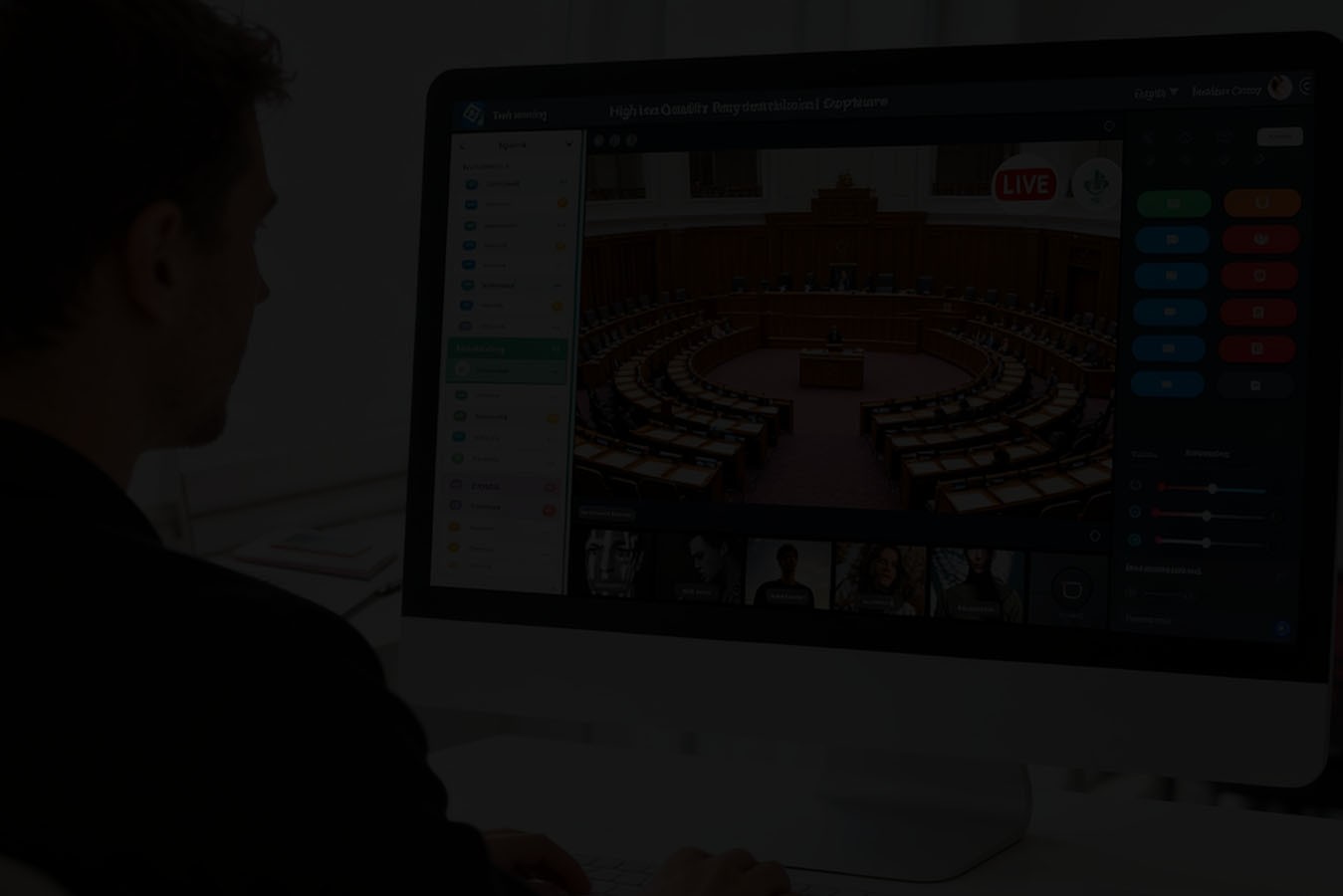
In-room delegates and remote participants in the same session. Live streaming with real-time chat, Q&A, and polling. Screen sharing for document presentation during testimony. Recording with automatic timestamping — critical for generating the official record or Hansard reference. Virtual lobby for pre-session networking and document access.
This isn't "we added a Zoom link." This is a unified experience where physical and remote participants interact through the same platform, see the same agenda, participate in the same polls, and appear in the same attendance records.
Zebra printer integration for on-demand badge printing. QR code, NFC, or facial recognition check-in — your choice depending on security level. Self-service iPad kiosks for high-volume public gallery access. And all of it works offline for secure buildings with restricted WiFi.
The badge designer is drag-and-drop, so your team can create credentials that display access zone information, delegate tier, dietary requirements for parliamentary dining rooms, and photo ID — without needing a graphic designer.
For inter-parliamentary conferences, InEvent integrates with travel systems (Amadeus, Sabre) for flight tracking, supports hotel room list management, meal vouchers, and ground transportation coordination. The protocol team manages the entire delegation journey from one dashboard — not five spreadsheets and three email threads.
Delegation sub-group management means the Speaker's delegation, the committee delegation, the press pool, and the support staff each have their own itineraries, access levels, and communications — all within one event.
InEvent's AI tools help small parliamentary event teams move faster. ChatGPT integration (via Azure OpenAI Service) drafts session summaries, delegate communications, and post-event reports in multiple languages. AI matchmaking connects delegates at inter-parliamentary networking events based on shared policy interests. Real-time AI audio transcription serves as both an accessibility feature and a practical tool for generating first-draft session transcripts. (Clerk review is still required for the official record — AI handles the heavy lifting, humans handle the precision.)
Attendance tracking across sessions and days. Engagement metrics — poll participation, Q&A activity, document access rates. Credential usage analytics showing who accessed which zones and when. Everything exportable for the Speaker's office, committee chairs, or parliamentary administration.
For parliaments that need to report on public engagement — how many citizens attended hearings, how many watched livestreams, how many submitted written testimony — these analytics turn what used to be a manual counting exercise into an automatic report.

Let's be straightforward about the options available, because parliamentary teams evaluating this space are looking at two completely different categories of technology.
1. e-Parliament vendors (Parliament.io, SBL eParliament, EY Legislative Management Suite)
These are excellent at what they do — bill drafting, statute codification, official electronic voting, Hansard generation, committee scheduling, document management. SBL's eParliament solution digitized India's Himachal Pradesh Legislative Assembly and claims 70% operational efficiency improvement. Parliament.io has 15 years of parliamentary experience with Microsoft 365 integration.
But none of them handle visitor registration, credential printing, onsite check-in, hybrid participation infrastructure, mobile apps for delegates, multilingual attendee communications, or travel management. They solve the legislative workflow. InEvent solves the event operations layer that sits on top of it. The two categories are complementary, not competitive.
2. Conference hardware (Televic, Bosch DICENTIS, Gonsin)
Physical infrastructure — microphones, interpretation booths, voting panels, camera tracking systems. Essential for the chamber itself. But hardware systems don't manage who enters the building, who's credentialed, who's registered for a committee hearing, or how 500 inter-parliamentary delegates access the agenda in their language. InEvent works alongside chamber hardware, managing the event layer that hardware can't touch.
3. OpenMeeting
This is the closest overlap. OpenMeeting offers legislative meeting management with electronic voting, agenda management, speaker queue tools, and automatic minutes generation. It's used well by U.S. city councils and school boards.
But there's no enterprise security stack (no SOC 2, no FAR/NDAA compliance), no offline check-in for secure buildings, no multilingual depth (InEvent supports 180+ languages), no AI suite, no travel management, and no credential printing at scale. For a county board meeting with 12 members and 30 observers, OpenMeeting works well. For a national parliament hosting an inter-parliamentary conference with 500 delegates from 40 countries, it's not built for that scale.
4. Cvent, EventsAir, Bizzabo
Enterprise event platforms with strong capabilities for corporate conferences. But none of them have parliamentary-specific content, workflows, or positioning. No voting and polling adapted for legislative procedures. No speaker queue management designed for hearings. No understanding of how committee testimony workflows operate. Could you technically run an inter-parliamentary conference on Cvent? Probably, with enough custom configuration. But you'd be building from scratch what InEvent provides out of the box.
5. InEvent
Bridges both worlds. Enterprise event management infrastructure — registration, credentialing, check-in, mobile app, hybrid streaming, AI tools, analytics — mapped to parliamentary requirements. Speaker queues, voting and polling, Robert's Rules support, multilingual proceedings, secure credential management, offline capability for government buildings. And the compliance stack (FAR, NDAA, SOC 2, GDPR) that government procurement requires.
Deploying new technology in a parliamentary environment isn't like signing up for a SaaS trial. There's a procurement process, a compliance review, and a security assessment before anything goes live. Here's what the actual deployment looks like.
Step 1: Security review and compliance check.
InEvent's security team works with your parliamentary IT and procurement officers. SOC 2 Type II report, GDPR Data Processing Agreement, and full compliance documentation are available under NDA. Security questionnaires get completed. Data residency requirements get confirmed — Virginia (US) or Dublin (EU) depending on your parliament's jurisdiction.
Step 2: Platform configuration.
Your dedicated project manager configures the platform to your parliament's branding — insignia, colors, chamber-specific styling. Permission levels get set up for your team structure (Speaker's office, clerk's department, committee staff, press office, public affairs, security). Language settings get configured. Event templates get built for your most common event types — committee hearings, public gallery access, press conferences — so your team isn't starting from scratch every time.
Step 3: Pilot event.
Run one event on the platform before your highest-stakes proceeding. A committee hearing. A public engagement program. A press conference. Test the registration workflow, check-in process, speaker queue management, and badge printing. Your project manager walks you through the dry run and helps troubleshoot.
Step 4: Full deployment.
Roll out across your parliamentary calendar. InEvent supports unlimited events on enterprise plans. Templates from your pilot become reusable starting points. Integration with existing e-Parliament systems happens where APIs allow — InEvent's architecture is built to complement, not replace, your existing legislative technology.
Support is 24/7, across all time zones, from a human — not a chatbot. Most parliamentary teams are fully operational within two to three weeks for straightforward deployments. Complex implementations with multiple integrations, custom SSO, and large-scale data migrations take four to six weeks.
Here's what it comes down to.
Your parliament has sophisticated technology for drafting bills, recording votes, and publishing official records. But the moment you need to register visitors, credential delegates, manage a speaker queue, or coordinate a 500-person inter-parliamentary assembly — you're back to spreadsheets and email chains.
That gap isn't just inefficient. It's a transparency problem, a security risk, and a missed opportunity to demonstrate to citizens that their legislative institution operates at the standard they expect from every other modern organization.
InEvent closes that gap. Enterprise event management infrastructure designed for the most security-conscious, protocol-sensitive, multilingual environments on earth. Every enterprise client gets a dedicated project manager. Every deployment starts with a security review. Every event runs on the same Microsoft Azure infrastructure that powers government operations worldwide.
Every parliament operates differently. Different procedures. Different security requirements. Different languages. Different scales. That's why we start with a conversation — a walkthrough mapped to your specific parliamentary calendar, your event types, and your operational needs.
1. What is parliamentary session software?
It's software that manages the operational and event management side of legislative proceedings. That includes registering visitors and delegates, managing credentials and access control, coordinating hybrid session participation, handling speaker queues for committee hearings, and supporting multilingual communications for inter-parliamentary conferences. It works alongside e-Parliament systems that handle the legislative process itself — bill drafting, official voting, journal generation.
2. Can InEvent handle electronic voting for parliamentary sessions?
InEvent's live polling supports real-time voting — anonymous or attributed, single or multi-choice, with live or delayed results. It's designed for committee straw polls, inter-parliamentary conference resolutions, caucus consultations, and public engagement votes. For official chamber voting on legislation (recorded divisions, roll-call votes), parliaments use dedicated electronic voting hardware. InEvent complements those systems rather than replacing them.
3. Does parliamentary session software work without internet?
InEvent's offline check-in with local device sync is specifically designed for government buildings with restricted WiFi. Credential verification, badge printing, and attendee data all cache locally on the check-in device. Data syncs automatically when connectivity restores. This is critical for parliamentary buildings where guest devices and vendor equipment can't access the parliamentary network.
4. How does InEvent handle speaker queue management for hearings?
Delegates, witnesses, or members of the public request to speak through the mobile app or an onsite kiosk. Requests queue automatically and appear on the presiding officer's dashboard. The chair manages the queue in real time — approving, reordering, declining, or allocating time blocks. Remote and in-person speakers are managed in the same queue. Time tracking keeps proceedings on schedule.
5. Can InEvent support inter-parliamentary conferences with delegates from many countries?
Yes. InEvent supports 180+ languages with auto-detection, delegate registration with credential printing, delegation management with sub-groups, travel and hospitality coordination (Amadeus/Sabre integration), multi-track agendas with simultaneous interpretation support, a branded mobile app with offline capability, and hybrid participation for remote delegates. It's built for exactly this scale of multilateral legislative event.