


One of our sales representatives will contact you shortly.
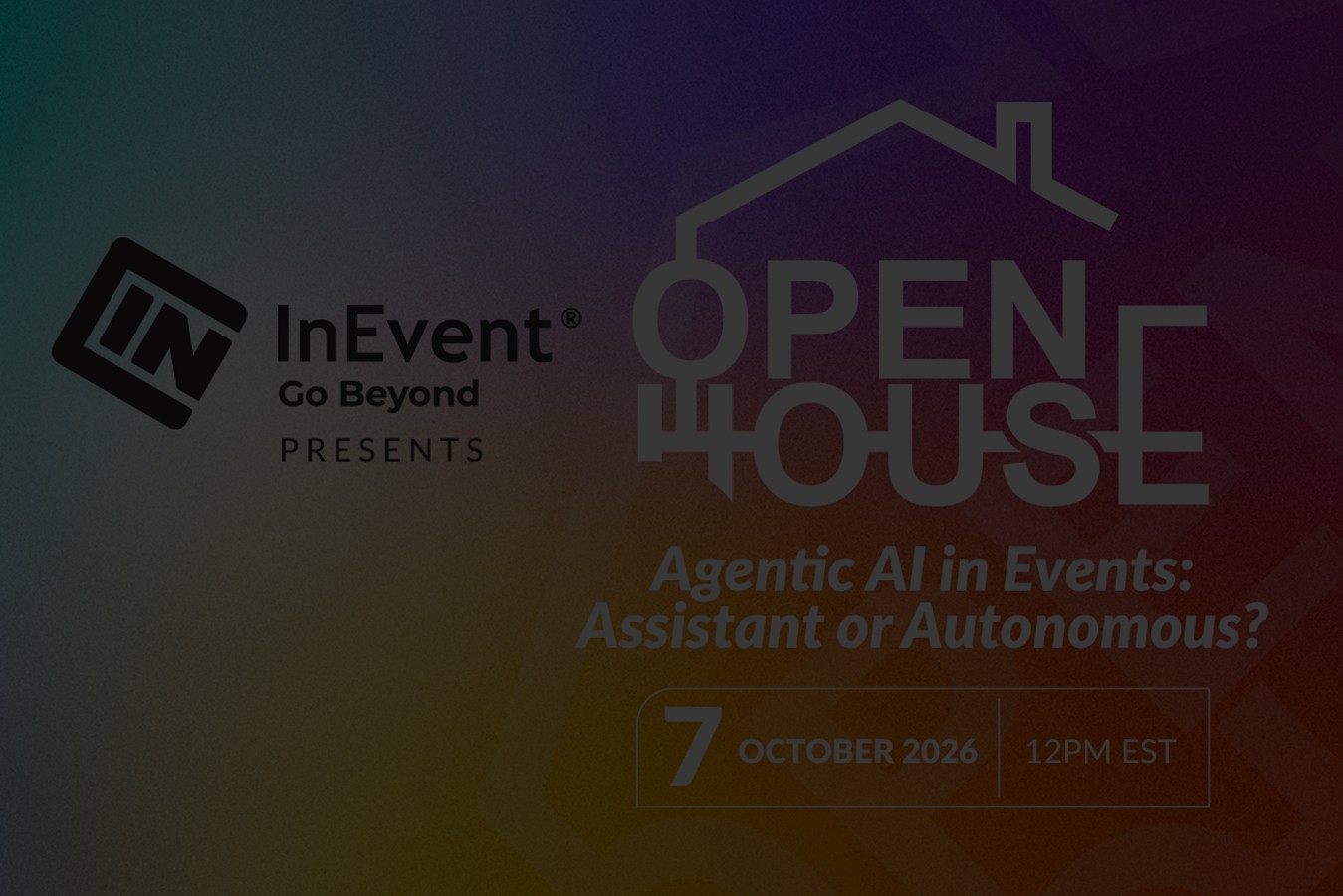
ATLANTA, Georgia, October, 2026 – Event professionals see content and communications as the area where AI could save them the most time, followed by data reporting and follow-up, according to a live audience poll at "Agentic AI in Events: Assistant or Autonomous?", the latest InEvent Open House. InEvent, the enterprise event management platform for in-person, hybrid, and virtual events, hosted the session on October 7, 2026, with Katie McIntyre, Director of Technical Architecture at Opus Agency, and Wendy Porter, Founder and Chief Event Strategist at Wendy Porter Events. Vinni Neris, CRO of InEvent, moderated.
A CHS Birmingham survey reported by M&IT found that more than 80% of event professionals have used AI tools in the past year, yet 58% say they only know the basics. InEvent's own State of Enterprise Events 2026 research found that 72% see AI as valuable or essential, while 26% have not brought it into their workflows at all.
Neris opened by asking whether AI will cost event professionals their jobs. McIntyre answered that it is both an opportunity and a threat, depending on who holds it. "I think of technology as a tool just like anything else," she said. "It's the same as with a hammer: in the hands of a skilled carpenter, very useful. "
McIntyre said the Opus Agency clients furthest along with AI are the ones that already had a mature data policy. "I don't want to have the AI conversation with you if we haven't already had the data conversation, because it is very much a garbage in, garbage out situation," she said.
Those teams use AI for pattern recognition: spotting gaps in long-held assumptions, studying last year's attendance patterns to build the schedule, tuning session lengths and the gaps between them, and researching competitors and price points. What separates the teams that get value from those that give up, she said, is data and intentionality. "It's not the tool, it's the wielder."
Porter, who runs her own event business, uses agentic AI to work through her inbox and flag follow-ups, build budgets, and prepare proposals. She updates project plans from similar past events and lets AI work back from key dates. "It used to take me maybe 30 hours to really assess something and do a proposal. Now I can do it in five," she said. The time saved goes to strategy, the guest experience and a better work-life balance.
She was candid that results are uneven. A test loading client numbers into her own budget template "didn't actually do as well as I had hoped," and she expects better results as she trains the tool on her templates and standard operating procedures.
On RFPs, McIntyre said her team gets the best results when AI does the groundwork and people do the rest. "If we let it get us a quarter of the way there, and then we engage human passion," she said, the proposals are stronger than fully generated ones. AI helps the team understand who the client is and what it has historically wanted, and the team maps its own services and passion back to that.
"I don't think you want to take the human element out," Porter said. "I use it for my foundational work and then make sure we're layering the human and what makes us different."
Neris described the same pattern at InEvent. Agentic AI reviews the company's RFP answers, flags what customers are looking for that is missing or weakly answered, and helps the team build tailored presentations in a fraction of the days it used to take. The team also uses AI to personalize trade show follow-up based on the conversations, dinners, and sessions each lead took part in, rather than sending one generic message.
In the live poll, most attendees chose content and communications as the area where AI could save them the most time, with data reporting and follow-up in second place.
McIntyre's own pick was logistics, pointing to the new wave of MCP connections that let AI act inside event platforms, the same approach behind InEvent MCP. "It is literally put thing A into place B," she said. "That's what excites me the most, because that's the thing that doesn't need my human curiosity." She also described AI as a "silo buster" for invitation-only programs: with CRM data anonymized, teams can see which contacts are actually showing buying signals rather than relying on title or company name alone.
Porter pointed to the manual work spread across prospectuses, client emails, and vendor documents. Using AI to pull the key details into project plans, she said, saves her team from toggling between dozens of sources. She also uses it for ideation and to tighten her writing, and recently laid out a client menu in ChatGPT before finishing it in Canva.
On attendee data, McIntyre said trust comes from "transparency and empowerment": letting attendees decide how much they share with AI agents, planning how data will be anonymized before it is collected, and giving people a real way to opt out. Porter said she agrees on data policies with clients up front and keeps her AI work private so client information is not used to train wider models.
"Anything it spits out needs human oversight and review," Porter said, recalling client research that turned out to be built on outdated information. "I don't think we're ever going to get away from face-to-face events."
McIntyre warned that an AI assistant choosing sessions on an attendee's behalf could move from being "a door" into the event to "a gatekeeper at the door," filtering out sponsor content and the exhibitors who depend on it. "The question is less what can AI accomplish and more what should AI accomplish," she said. "It is critical to preserve friction. AI removes a lot of that, but friction is how we learn."
"AI is a tool. It's not something that will replace us, and we need to use it wisely," Neris said. "We need to spend a good amount of time reviewing what it's doing."
Following the session, InEvent published "Agentic or Generative?", a one-page starter guide answering the questions attendees raised. It explains that generative AI creates a draft, summary, or idea when prompted, while agentic AI acts within set guardrails: reading data, updating records, sending messages, and moving work forward.
InEvent Open House sessions stream live from the InEvent Live Studio and are not available on demand. Event professionals heading to IMEX America 2026 can continue the conversation with the InEvent team at Booth B4595, October 13–15 at Mandalay Bay Convention Center in Las Vegas, and see how InEvent's AI suite supports registration, communications, and event data. Open House attendees who meet with the team at the booth are entered for the chance to win a Coach bag, with the winner drawn after the show.
InEvent is an enterprise event management platform for in-person, hybrid, virtual, and webinar experiences. Organizations worldwide use InEvent to manage event registration, websites, attendee communications, on-site check-in and badge printing, mobile event apps, engagement, analytics, and AI-powered event workflows from one connected platform. Learn more at inevent.com.